
Imagine the scene: you’ve just spent three hours at a dealership, the smell of “new car” is still intoxicating, and you’ve finally signed a 72-month financing agreement for a stunning, high-tech luxury SUV. You drive off the lot feeling like a million bucks. But fast forward just twenty-four months, and you realize that while you still owe $55,000 on that loan, the car is now worth barely $30,000 on the open market. You are officially “underwater,” trapped in a high-interest cage with a vehicle that is losing value faster than a smartphone with a cracked screen. It’s a financial nightmare that happens to thousands of well-meaning buyers every single year.
In April 2026, the automotive market has split into two very different worlds. On one side, you have the “Value Kings”—cars that hold their worth and offer low-cost ownership. On the other, you have the “Equity Vampires.” These are the Worst Cars to Finance, and they aren’t always “bad” cars in the traditional sense. Some are beautiful, fast, and packed with the latest gadgets. However, due to a combination of brutal depreciation rates, high maintenance costs, and a shifting technological landscape (especially in the EV sector), financing these specific models is essentially a form of slow-motion financial self-sabotage. If you want to protect your net worth, you need to know which badges to stay away from in the finance office.
The Depreciation Trap: Luxury and High-End EVs
The biggest enemy of a long-term car loan is depreciation. When you finance a car, you are betting that the vehicle will retain enough value to cover the remaining balance of the loan if you ever need to sell it. In 2026, that bet is becoming increasingly dangerous for luxury buyers and early adopters of specific electric platforms.
According to recent industry data, luxury behemoths like the BMW 7 Series and the Maserati Levante are leading the race to the bottom, with some models losing over 60% of their value in just five years. But the real “depreciation crisis” of 2026 belongs to the high-end EV market. Cars like the Jaguar I-PACE and even certain Tesla Model X configurations have seen equity “evaporate” as manufacturers slash new-car prices and battery tech makes older models feel obsolete overnight. When you finance a car that loses $50,000 in value while you’ve only paid down $10,000 of the principal, you are stuck in a hole that is almost impossible to climb out of.

The “Money Pit” Models: Reliability vs. Loan Terms
Financing is a long-term commitment, often lasting five to seven years. The “Worst Cars to Finance” are those whose warranties expire long before the loan does, leaving you to pay both a monthly car note and a massive repair bill simultaneously. In 2026, mechanics and consumer advocates are sounding the alarm on several popular but problematic models.
The Land Rover Range Rover and the Jeep Wrangler continue to be high-risk financing targets. While they offer prestige and ruggedness, their recurring failures in electronic systems and transmissions can lead to “maintenance muggings.” Imagine still owing $40,000 on a 2024 Land Rover in 2028, only to be hit with an $8,000 suspension repair that isn’t covered by warranty. This is why these cars are often better candidates for leasing—where the manufacturer holds the risk—rather than financing, where you are left holding the bill.
Specific Models to Approach with Caution
If you see these names on your “must-have” list, it’s time to take a very hard look at the math before you sign that finance contract:
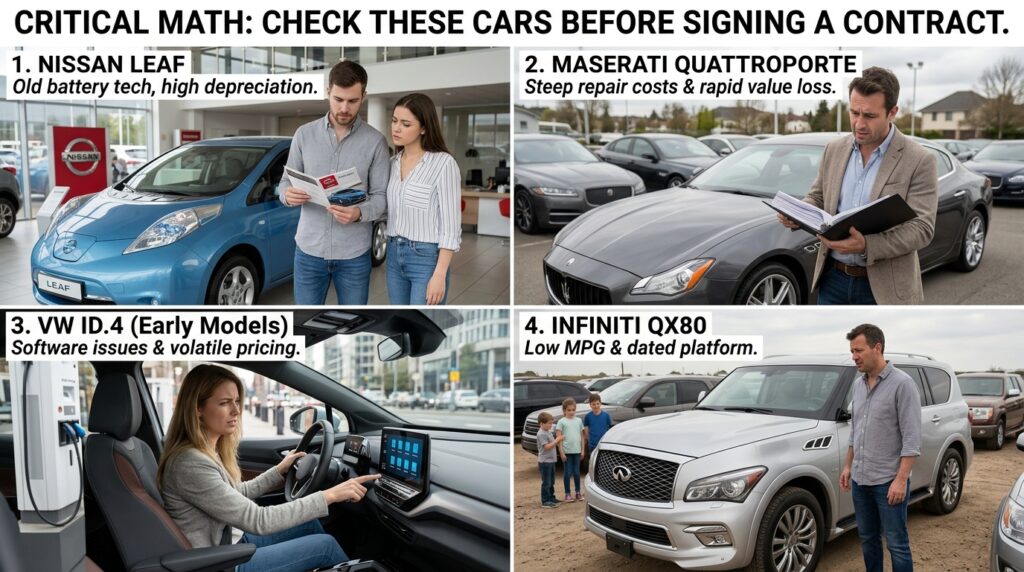
1. Nissan LEAF
Once a pioneer, the LEAF has struggled to keep pace with modern thermal management for its batteries. In 2026, its resale value has collapsed, with some units losing over 63% of their value. Financing a LEAF is essentially paying for yesterday’s technology at today’s prices.
2. Maserati Quattroporte / Ghibli
Italian style comes at a massive financial cost. These cars suffer from a “double whammy” of suspect long-term reliability and a used car market that is terrified of their repair costs. They are among the fastest-depreciating executive sedans in the world.
3. Volkswagen ID.4 (Early Models)
Software disasters and aggressive price cuts on newer versions have crushed the used prices for the ID.4. Owners have seen nearly 33% of their value vanish in just two years. If you must have one, look for a deep discount on a used model rather than financing a new one.
4. Infiniti QX80
Until the recent redesigns, the QX80 was essentially a “luxury” wrapper on ancient architecture. With dismal fuel economy and high depreciation (around 65% over five years), it’s a difficult asset to justify on a balance sheet.
Is it worth it?
Is it ever worth financing one of these “high-depreciation” models? In a purely financial sense, the answer is almost always no.
However, we don’t live our lives solely on spreadsheets. If you absolutely love the way a Range Rover drives or the status a Maserati brings, there is a way to do it without going broke. The key is to avoid long-term financing. If you can’t afford to pay off the car in 36 months or less, you shouldn’t be financing a high-depreciation vehicle. By the time the car starts to break down or the value bottoms out, you should already own it outright. Financing these cars for 72 or 84 months is a recipe for being “perpetually underwater,” which is the single biggest mistake people make in the car market.
What to Consider Before You Choose
If you are currently looking at a car that has a reputation for being a “bad finance,” ask yourself these three critical questions:
1. What is the 5-Year Residual Value?
Before you sign, look up the “iSeeCars” or “CarEdge” 5-year depreciation ranking for that model. If the car is projected to lose more than 50% of its value, you need to be putting at least 25% down at the start of the loan to stay “above water.”
2. Can I Afford the “Out-of-Warranty” Phase?
Most car loans in 2026 last 6 years, but most bumper-to-bumper warranties last only 3 or 4. If you are financing a BMW or a Mercedes, do you have a dedicated “emergency fund” for when those high-tech sensors start to fail in year five? If the answer is no, you are better off with a Toyota or a Honda.
3. Is there a “Green” Incentive?
For some EVs, federal tax credits can offset the depreciation. However, don’t rely on this. In 2026, the used market is already pricing in those tax credits, meaning the used price of the car drops by the same amount as the credit. The “discount” you get at the start is often lost when you try to sell.
Important Tips
-
Lease the “Risk,” Finance the “Value”: If a car is known for high depreciation and poor reliability (like a Land Rover or an Audi A4), lease it. Let the bank worry about what it’s worth in three years. Save financing for cars like the Subaru Crosstrek or Toyota Tacoma.
-
The “20/4/10” Rule: Put 20% down, finance for no more than 4 years, and make sure the payment is less than 10% of your income. If a car doesn’t fit this rule, it’s a “Worst Car to Finance” for your specific budget.
-
Always Buy GAP Insurance: If you insist on financing a high-depreciation car with a low down payment, GAP insurance is your only safety net. Without it, a total-loss accident could leave you owing the bank $15,000 for a car you can no longer drive.
-
Check RepairPal Ratings: Before you buy, check the average annual repair cost for your model. If it’s over $1,000, that’s a “hidden” monthly payment you need to factor into your loan.
The Psychological Weight of a Bad Asset
There is a unique kind of stress that comes from “hating” your car loan. We’ve all seen it: someone driving a beautiful luxury car but complaining constantly about the payment, the latest check-engine light, and the fact that they can’t afford to trade it in.
That car becomes a source of resentment rather than a source of joy. In 2026, the smartest luxury is the luxury of choice. When you finance a car that holds its value, you have the choice to sell it, trade it, or keep it. When you finance one of the “Worst Cars to Finance,” you lose that choice. You are stuck until the loan is over. True wealth isn’t just about what you drive; it’s about not being a slave to the machine in your driveway.
Conclusion: Stop the Equity Bleed
Protecting your financial future starts with the decisions you make in the dealership’s back office. While it’s easy to get swept up in the excitement of a new vehicle, you must remember that a car is primarily a tool—and sometimes, it’s a very expensive liability.
Avoid the high-depreciation traps of the luxury EV sector, stay wary of European executive sedans with suspect long-term reliability, and never stretch a loan on a vehicle that will be worth pennies on the dollar by the time you’re done.
If you want the luxury experience, lease it. If you want a solid investment, finance a “Value King.” But whatever you do, don’t let a “Equity Vampire” bleed your savings dry. Do your research, look at the 5-year data, and drive a car that works for you—not a car that makes you work for it. Happy (and smart) car hunting!