
We often think of a car loan as a simple math problem: your credit score plus your down payment should equal a “yes” or a “no.” But have you ever noticed that the application asks for more than just your income? It wants to know where you work, how long you’ve been there, and even your job title. You might wonder why a bank cares if you are a software engineer, a nurse, or a freelance graphic designer as long as the money hits your account every month. The truth is, your career choice and your employment history are secret ingredients in the lender’s recipe for risk. They aren’t just looking at how much you earn today; they are trying to predict if you will still be earning that same amount three, four, or five years from now.
When you ask, Does Your Job Affect Car Loan Approval?, the answer is a resounding yes, but perhaps not in the way you expect. In the modern lending landscape of 2026, banks have become incredibly sophisticated at analyzing “stability markers.” They use massive databases to determine which industries are booming and which are shrinking. A high salary in a volatile industry might actually be less attractive to a lender than a modest salary in a rock-solid profession. If you’ve ever felt like your job was holding back your ability to get the keys to a new ride, or if you’re planning a career move and wondering how it will impact your next purchase, it’s time to look at the “employment” section of your application through the eyes of a bank.
Stability: The Holy Grail of Lending
From a lender’s perspective, the ideal borrower is “boring.” They want someone who has worked at the same company for ten years, lives in the same house, and gets a predictable paycheck every two weeks. Why? Because boring is predictable. When you apply for a car loan, the bank is essentially betting on your future. If you have a long history of steady employment in a stable field, the bank feels confident that you will have the funds to cover your 48th or 60th payment just as easily as your first.
On the flip side, if your resume looks like a collection of short-term gigs or frequent industry hops, the bank sees “volatility.” Even if you are making more money with each move, the lack of tenure suggests that if the economy takes a dip, you might be the first one out the door. In 2026, many lenders look for at least six months to a year at your current job, and at least two years of consistent history in the same field. If you just switched from being a chef to being a real estate agent, the bank might hit the “pause” button on your approval until you can prove your new income is sustainable.
Industry Trends and Risk Scores
Believe it or not, banks actually assign risk scores to different occupations. This isn’t about prestige; it’s about statistics. Certain jobs are viewed as “recession-proof.” Healthcare professionals, government employees, and specialized technicians often find it easier to get approved because their roles are essential regardless of the economic climate. If you are a registered nurse, a lender knows there is a 99% chance you will be employed for the duration of your loan.
Conversely, industries that rely heavily on discretionary spending—like high-end travel, luxury retail, or certain sectors of the entertainment industry—can be flagged during economic downturns. Additionally, the “gig economy” has changed the game. If you are a full-time ride-share driver or a freelance creator, you might face more scrutiny. It’s not that the bank doesn’t want your business; it’s that they need more proof. They will likely ask for two years of tax returns instead of a simple pay stub to see the “average” of your earnings rather than a single lucky month.
The “Probationary Period” Trap
One of the most common mistakes I see is someone trying to buy a car the same week they start a dream job. You’ve got the signed offer letter, the salary is 20% higher than your last role, and you want to celebrate with a new car. However, many lenders will see that you are in a “probationary period.” Most companies have a 90-day window where they can let an employee go without much cause.
Lenders know this. If you apply during those first 90 days, you might find yourself facing a rejection or a much higher interest rate. If you can wait until you’ve cleared that three-month hurdle and have a few full pay stubs in hand, your approval odds will skyrocket. The bank wants to see that you’ve actually “landed” in the position before they hand you thousands of dollars.
Worth It?
Is it worth staying in a job you don’t like just to get a car loan? Or is it worth waiting to buy a car until you’ve been at a new job for a year? This is a balance between your life goals and your financial needs. If your current car is a safety hazard, you can’t wait a year for a new one. In that case, you might have to accept a higher interest rate now and plan to refinance later once your job tenure is established.
However, if you have the luxury of time, it is absolutely worth it to synchronize your car purchase with your professional stability. Getting a loan when you have two-plus years of tenure can save you thousands of dollars in interest over the life of the loan. In my experience, a “stable” worker with a 680 credit score often gets a better deal than a “job hopper” with a 720 score. Stability is a currency in the banking world—make sure you’re spending it wisely.
What to Consider Before Choosing
Before you fill out that employment section on the loan app, think about how these three factors might look to a computer algorithm:
The “Same Field” Rule
If you change jobs but stay in the same industry—moving from one accounting firm to another, for example—most lenders will count that as continuous employment. They see that your skills are transferable and your income stream is likely to continue. It’s the “career pivots” (going from accounting to opening a bakery) that trigger the red flags. If you’ve recently pivoted, be prepared to explain the move to a human underwriter.
The Type of Income (W2 vs. 1099)
Are you a standard employee (W2) or a contractor (1099)? Standard employees are much easier for banks to verify. If you are a contractor, the bank knows that your taxes aren’t withheld, which means your “net” income is much lower than it appears. If you are 1099, you should consider your “taxable income” after deductions as your real income. If you write off everything to save on taxes, you might accidentally make yourself look too “poor” to qualify for a car loan.
Distance to Work
It sounds strange, but some advanced lending models in 2026 look at the distance between your home and your office. If you live 100 miles from your job, the lender sees a high risk of “burnout” or high vehicle depreciation. They know you’ll be putting 30,000 miles a year on the car, which lowers its value quickly. If you work remotely, make sure that is clearly stated so the lender doesn’t wonder why your office is in another state.
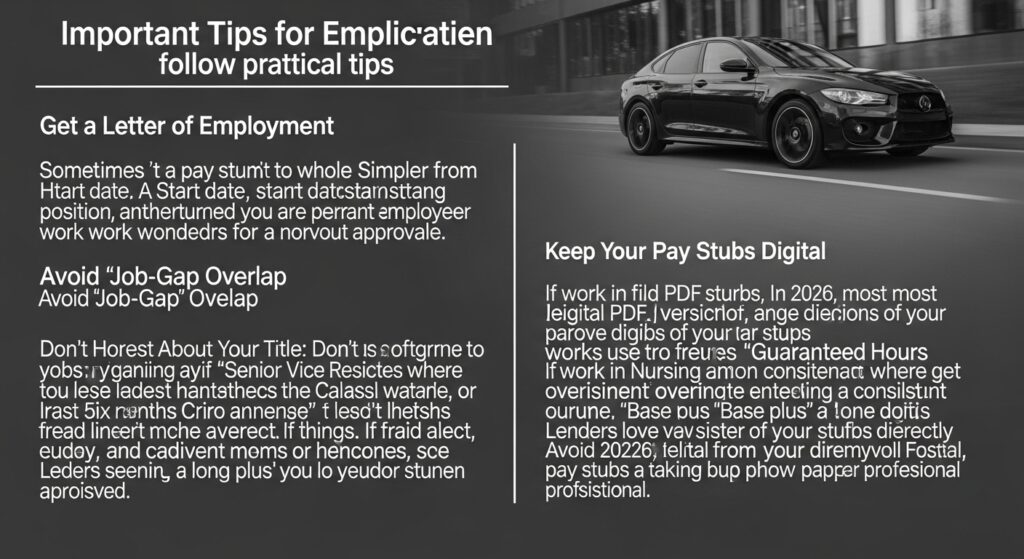
Important Tips for Employment Verification
If you want to ensure your job helps rather than hurts your approval, follow these practical tips:
-
Get a Letter of Employment: Sometimes a pay stub doesn’t tell the whole story. A simple letter from your HR department stating your start date, position, and that you are a permanent employee can work wonders for a nervous lender.
-
Avoid “Job-Gap” Overlap: If you are planning to switch jobs, try to get the car loan before you leave your old one (where you have tenure) or at least six months after starting the new one. The “in-between” phase is the danger zone for approvals.
-
Be Honest About Your Title: Don’t inflate your job title. Lenders use software to verify if a “Senior Vice President” salary matches the local average. If things don’t line up, it triggers a fraud alert.
-
Highlight “Guaranteed” Hours: If you work in a field like nursing or manufacturing where you get consistent overtime, show that it is a regular part of your income. Lenders love seeing a “base plus” structure as long as it’s consistent.
-
Keep Your Pay Stubs Digital: In 2026, most lenders want digital PDF versions of your pay stubs directly from your payroll portal. Avoid taking blurry photos of paper stubs; it slows down the process and looks less professional.
The 2026 Perspective: AI and Industry Forecasting
The way jobs affect car loan approval is changing. We are seeing lenders use predictive AI to look at the “health” of specific companies. If you work for a tech startup that just announced layoffs, the bank might see that news in real-time and tighten their requirements for you. Conversely, if you work for a company with a massive new government contract, the bank might see you as a “preferred” borrower. Your employment is no longer just a line on a form; it’s a data point in a global economic map.
Conclusion
So, Does Your Job Affect Car Loan Approval? It certainly does. Your career is the engine that powers your financial life, and lenders are simply checking to see if that engine is reliable enough for a long-distance journey. Whether you are a seasoned professional with decades of tenure or a gig-economy worker carving out a new path, the key is to present your employment as a story of stability and growth.
Don’t be discouraged if your job situation isn’t “perfect.” There is a lender for almost every type of worker. The goal is to understand how your career looks on paper and to address any potential concerns before they become a “no.” By timing your purchase correctly and providing the right documentation, you can make your job the strongest part of your application.
Your career is about more than just a paycheck—it’s the foundation of your creditworthiness. Treat it with the same care you would your credit score, and you’ll find that the road to car ownership becomes much smoother. Good luck with the new job, and even better luck with the new car!