
You’re sitting in the dealership lounge, nursing a lukewarm cup of coffee, and the finance manager hands you two sheets of paper. On the left, a “Sign and Drive” deal—zero dollars out of your pocket today, but a monthly payment that makes you wince. On the right, a plan where you hand over $5,000 upfront, which drops your monthly bill to something much more manageable. It’s a classic financial tug-of-war. Do you keep your cash in the bank for a rainy day, or do you “buy down” your debt right now to save on interest? Most people choose based on emotion, but the real winner is hidden in the math and your personal lifestyle.
Buying a car is one of those rare moments where a single decision can ripple through your finances for the next five to seven years. In 2026, with shifting interest rates and fluctuating vehicle values, the “right” answer isn’t as obvious as it used to be. Whether you are eyeing a brand-new electric vehicle or a reliable used SUV, understanding the long-term impact of that initial down payment is crucial. We’re going to break down the real-world simulations of “$0 Down vs $5,000 Down: What’s Better?” so you can stop guessing and start signing with confidence.
The Psychology of the Down Payment
Before we look at the spreadsheets, let’s talk about how our brains handle this choice. There is a certain “pain” associated with parting with $5,000 in one go. That’s a vacation, a home repair fund, or a solid emergency cushion. On the other hand, there is a “slow-burn pain” of seeing an extra $100 or $150 disappear from your paycheck every single month for the next 60 months.
Most dealerships love the $0 down option because it lowers the “barrier to entry.” It makes it incredibly easy to say yes to a car you might not otherwise afford. But as the old saying goes, there’s no such thing as a free lunch. When you put $0 down, you aren’t avoiding the cost; you’re just pushing it into the future, usually with interest attached to it like a heavy backpack.

Real Numbers: The 60-Month Simulation
To see the true impact, let’s run a simulation on a $35,000 vehicle. We will assume a standard 7% interest rate and a 5-year (60-month) loan term. This is a very common scenario in today’s market.
Option A: The $0 Down Path
-
Total Amount Borrowed: $35,000 (plus taxes and fees rolled in)
-
Monthly Payment: ~$693
-
Total Interest Paid: ~$6,580
-
Total Cost of Loan: $41,580
Option B: The $5,000 Down Path
-
Total Amount Borrowed: $30,000
-
Monthly Payment: ~$594
-
Total Interest Paid: ~$5,640
-
Total Cost of Loan: $35,640 (plus the $5k upfront)
The Result: By putting $5,000 down, you save roughly $940 in interest alone over the life of the loan. More importantly, your monthly cash flow is $99 higher every single month. That’s nearly $100 that can go toward groceries, gas, or your savings account. Over five years, that “extra” $100 a month feels like a significant raise in your standard of living.
The Hidden Danger: Negative Equity
This is the part of the conversation that most salespeople gloss over. Vehicles depreciate—it’s just a fact of life. The moment you drive that car off the lot, it loses a chunk of its value. If you put $0 down, you are immediately “underwater” or “upside down” on the loan. This means you owe the bank more than the car is worth.
Why does this matter? Imagine a year from now, you get into a bad accident and the car is totaled. The insurance company will only pay you what the car is worth, not what you owe. If the car is worth $28,000 but your $0 down loan still has a balance of $32,000, you have to write a check for $4,000 to the bank for a car you can no longer drive. Putting $5,000 down acts as a “safety buffer” against this financial nightmare.
Is it worth it?
When asking if a $5,000 down payment is worth it, you have to look at your “Opportunity Cost.” This is a fancy way of asking: “What else could I do with that $5,000?”
When $0 Down Makes Sense
If you have $5,000 but your credit card debt is sitting at 24% interest, use that money to pay off the cards first! Borrowing car money at 7% to pay off debt at 24% is a brilliant move. Also, if you’re a business owner and can deduct the full monthly payment as an expense, keeping the cash in your business for inventory might yield a higher return than the interest you’d save on a car loan.
When $5,000 Down Wins
For most average consumers, the $5,000 down payment is the superior choice. It lowers your debt-to-income ratio, which makes it easier to get a mortgage or other loans later. It also gives you instant equity. If your life changes—maybe you have a baby or move to a city with great public transit—having equity means you can sell the car easily without having to pay the bank to take it off your hands.

What to Consider Before You Choose
Before you decide on the $0 Down vs $5,000 Down debate, ask yourself these three questions:
1. What is your “Emergency Fund” status?
Never drain your last cent for a down payment. If that $5,000 is all the money you have in the world, do not give it to the dealership. Keep $3,000 for emergencies and put $2,000 down. Being “car rich” and “cash poor” is a recipe for stress when the water heater breaks or you need a root canal.
2. What is the Interest Rate?
If you are lucky enough to qualify for a 0% or 1.9% APR promo, putting money down is actually a bad move mathematically. Why? Because you can put that $5,000 into a high-yield savings account earning 4% or 5%. You’d literally be making money by keeping your cash and using the bank’s “free” money to buy the car.
3. How long do you plan to keep the car?
If you trade in cars every two or three years, $0 down is very risky because you’ll never reach the “break-even” point where you actually own something of value. If you plan to keep the car for ten years, the down payment matters less in the long run, but it still saves you that initial interest hit.
Important Tips
-
The 20/4/10 Rule: Financial experts often suggest putting 20% down, financing for no more than 4 years, and ensuring total car costs (payment + insurance) don’t exceed 10% of your take-home pay. While $5,000 might not be 20% of a modern car, it’s a great start.
-
Gap Insurance is Mandatory for $0 Down: If you absolutely must go with $0 down, you must buy Gap Insurance. It covers the “gap” between what you owe and what the car is worth in case of a total loss. Without it, you’re gambling with your financial future.
-
Negotiate the Price First: Don’t tell the dealer how much you have for a down payment until you’ve agreed on the final sale price of the car. Dealers sometimes try to “absorb” your down payment by giving you a worse price on the vehicle itself.
-
Use Your Trade-In: Remember that a trade-in is a down payment. If your old car is worth $5,000, that counts! You don’t necessarily need to cough up $5,000 in cash if you have a vehicle with value.
The Lifestyle Impact
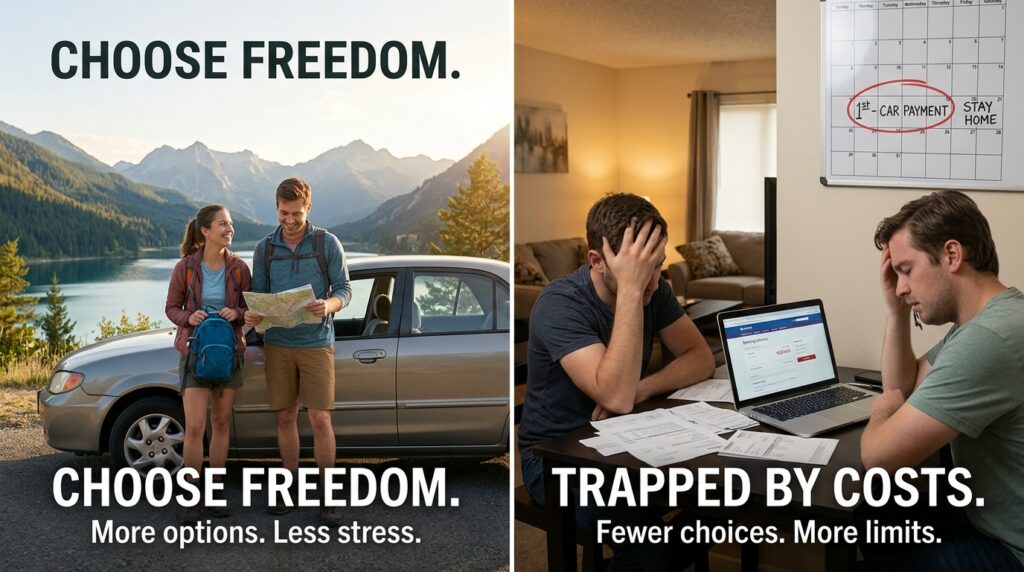
We often forget that car payments are a “fixed cost” that limits our freedom. A $700 payment ($0 down) means you have less flexibility to change jobs, take a lower salary for a dream career, or travel. A $500 payment ($5,000 down) gives you $200 of “breathing room” every month. That’s the difference between saying “yes” to a weekend getaway and having to stay home because the car payment is due on the 1st.
Conclusion: Making the Right Move
In the battle of $0 Down vs $5,000 Down: What’s Better?, the winner is almost always the down payment—if you can afford it without emptying your safety net. By putting money down, you’re buying more than just a lower interest rate; you’re buying peace of mind and protection against market volatility.
If you find yourself in a position where $0 down is the only way you can get into a car, take a moment to breathe. Ask yourself if you’re buying “too much car.” Sometimes, choosing a slightly cheaper model and putting even $2,000 down is a much smarter move than stretching for a luxury model with zero equity.
Your car should be a tool that gets you to your future, not a weight that holds you back. Run your own numbers, check your savings, and choose the path that makes your monthly budget feel light and your future feel secure. Whether it’s $0 or $5,000, being informed is the best investment you can make. Safe travels!