
Leasing vs Financing: Which One Saves You More Money Today?
Stepping onto a car lot in 2026 feels a bit like entering a high-tech showroom where the options are as sleek as the vehicles themselves. But once the excitement of the test drive fades, the real challenge begins: deciding how to pay for it. The age-old debate of Leasing vs Financing has taken on new layers this year, with shifting interest rates and the rapid evolution of electric vehicles changing the math for everyday drivers. It’s no longer just a question of “buying vs. renting,” but a strategic financial move that dictates your monthly cash flow for years to come.
The truth is, neither option is a universal “winner.” What saves your neighbor money might cost you a fortune depending on your driving habits, your tax situation, and how long you plan to keep the car. To truly understand which path leads to more savings, we have to look past the monthly payment and dive into the long-term equity, maintenance costs, and the hidden fees that often lurk in the fine print. Let’s break down the mechanics of both so you can navigate the dealership with total confidence.
Understanding the Fundamentals: What’s the Real Difference?
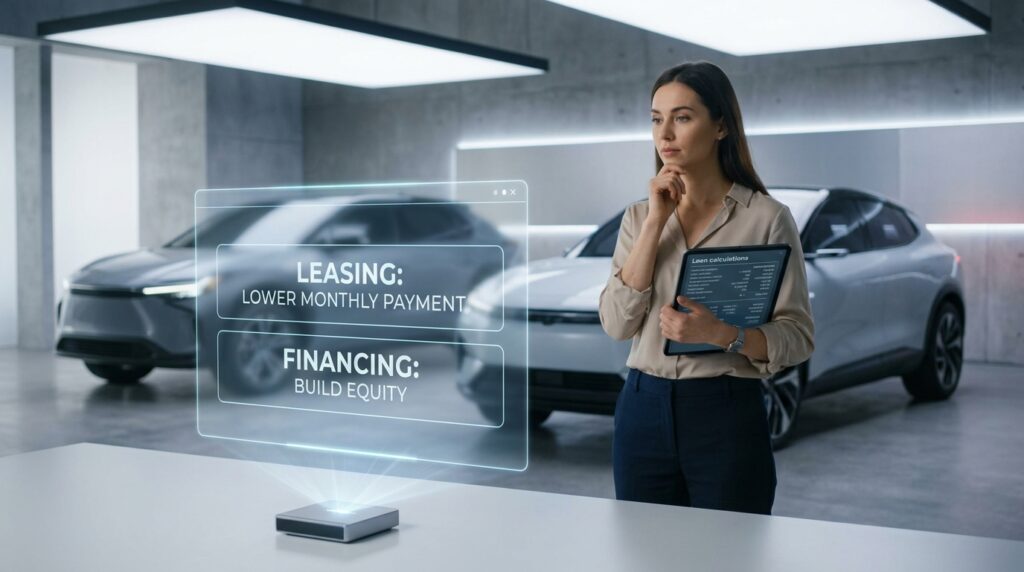
Before we look at the spreadsheets, let’s define our terms. Financing is the traditional route to ownership. You take out a loan, pay it back over time with interest, and once that final payment clears, the car is yours to keep, sell, or drive until the wheels fall off. You are building equity in an asset, even if that asset is depreciating.
Leasing, on the other hand, is essentially a long-term rental. You are paying for the “use” of the car during its most trouble-free years. Your payments don’t cover the full value of the vehicle; instead, they cover the difference between the car’s current price and its predicted value at the end of the lease (the residual value). Because you aren’t paying for the whole car, the monthly check is usually smaller, but you generally have to give the keys back when the clock runs out.
The Financial Mechanics of Financing
When you choose to finance, you are playing the long game. In 2026, loan terms have stretched, with some lenders offering 72 or even 84-month options. While these long terms make the monthly cost look attractive, they are often a trap. The longer you take to pay, the more interest you accrue, and you might find yourself “underwater”—owing more on the loan than the car is worth.
The Power of Ownership
The biggest financial “save” with financing happens after the loan is paid off. Imagine three or four years of driving with zero monthly payments. That is money that stays in your pocket or goes into your investments. While you will eventually face higher maintenance costs as the car ages, those costs are almost always lower than a monthly car payment.
Depreciation: The Silent Tax
The downside of financing is depreciation. A new car can lose 20% of its value in the first year alone. When you finance, you bear the full brunt of that loss. If you plan to sell the car in three years, you might find that the “savings” you thought you were building in equity have been swallowed up by market decline.
The Strategy Behind Leasing
Leasing has evolved into a lifestyle choice for those who value predictability and technology. In 2026, with automotive tech moving faster than ever, leasing allows you to “upgrade” your car just like you upgrade your smartphone. You get the latest safety features and battery tech without worrying about how much the car will be worth in the future.
Lower Monthly Outlay
Since you’re only paying for the depreciation that occurs during your lease term, your monthly payments are typically 30% to 50% lower than financing the same vehicle. This frees up cash for other expenses or investments, which is a form of saving in itself if you handle that extra cash wisely.
The Maintenance Safety Net
Most leases coincide with the manufacturer’s bumper-to-bumper warranty. This means your out-of-pocket expenses for repairs are virtually zero. For many, the “savings” in a lease come from the avoidance of the “big repair bill” that often hits older, financed cars.
Comparative Breakdown: Leasing vs Financing
To see which one saves you more, let’s look at a realistic three-year comparison for a $40,000 SUV.
The Financing Scenario (60 months at 5% interest)
-
Monthly Payment: Approximately $750
-
Total Paid after 3 years: $27,000
-
Remaining Balance: ~$17,500
-
Estimated Value of Car: ~$24,000
-
Net Equity: $6,500
The Leasing Scenario (36 months)
-
Monthly Payment: Approximately $450
-
Total Paid after 3 years: $16,200
-
Net Equity: $0
In this snapshot, the leaser spent nearly $11,000 less in cash over three years. However, the buyer has $6,500 in equity. If the buyer keeps the car for 6 or 7 years, they eventually “win” the savings race. If the buyer sells at year three, the leaser actually came out ahead in terms of total cash flow.
What to Consider Before Choosing
Choosing between Leasing vs Financing isn’t just about the math; it’s about your lifestyle and how you treat your property.
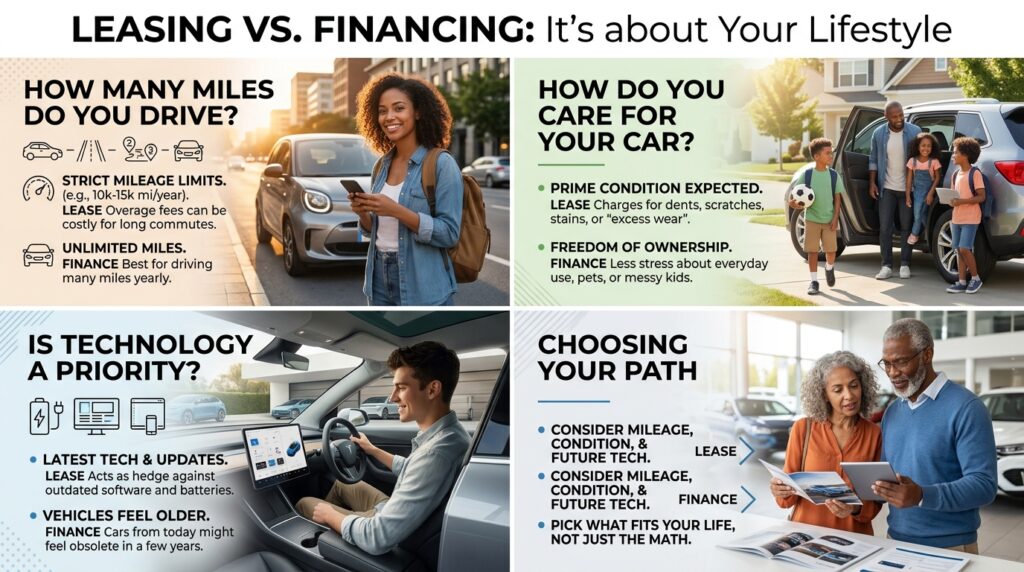
How many miles do you drive? Leases come with strict mileage limits, usually between 10,000 and 15,000 miles per year. If you have a long commute, the overage fees at the end of a lease (often $0.25 per mile) can wipe out any initial savings. If you drive 20,000 miles a year, financing is almost always the cheaper option.
How do you care for your car? Leasing companies expect the car back in “prime” condition. Small dents, stained upholstery, or scratched rims can result in “excess wear and tear” charges. If you have young kids or pets that treat the backseat like a playground, the freedom of owning (financing) saves you the stress and the end-of-contract penalties.
Is technology a priority? With the shift toward software-defined vehicles, a car from 2026 might feel obsolete by 2030. If you always want the latest AI driving assistants and range-efficient batteries, leasing acts as a hedge against technological obsolescence.
Pros and Cons at a Glance
Financing
-
Pro: You eventually own the asset and eliminate the monthly payment.
-
Pro: No limits on mileage or modifications (you can paint it neon green if you want).
-
Con: Higher monthly payments and the risk of being “upside down” on the loan.
-
Con: You are responsible for all repairs once the warranty expires.
Leasing
-
Pro: Lower monthly payments and lower upfront costs (often $0 down).
-
Pro: You are always driving a car under warranty with the newest tech.
-
Con: You never stop making payments; it’s a perpetual cycle of debt.
-
Con: Strict rules on mileage and vehicle condition.
Practical Tips for Saving More Money
Regardless of which path you take, there are ways to tilt the scales in your favor.
-
Check for “Subvented” Rates: Manufacturers often offer special interest rates (like 0.9% APR) on financing or “lease specials” to move specific inventory. Always check the manufacturer’s website before talking to a dealer.
-
Negotiate the Capitalized Cost: People often forget that you can negotiate the price of a car even if you are leasing. A lower “cap cost” means lower lease payments.
-
The Gap Insurance Factor: If you finance with a small down payment, you need Gap Insurance to cover the difference if the car is totaled. Many leases include this for free, while buyers have to pay extra for it.
-
Consider the “Lease Buyout”: If your leased car is worth more at the end of the term than the residual price in the contract, you can buy it and sell it for a profit. This is a “secret” way leasers sometimes build equity.
Is It Worth It?
“Worth” is subjective. If you find peace of mind in having a fixed, lower monthly cost and no repair headaches, leasing is worth every penny. You are paying for the service of transportation. However, if you view a car as an investment that should eventually be “free” to drive once the debt is cleared, financing is the only way to go.
In the current 2026 economy, we are seeing more people lean toward financing but with a twist: they keep the car for at least eight years. This “buy and hold” strategy is the undisputed king of saving money. It allows you to amortize the high initial cost over nearly a decade of use.
Important Considerations for 2026
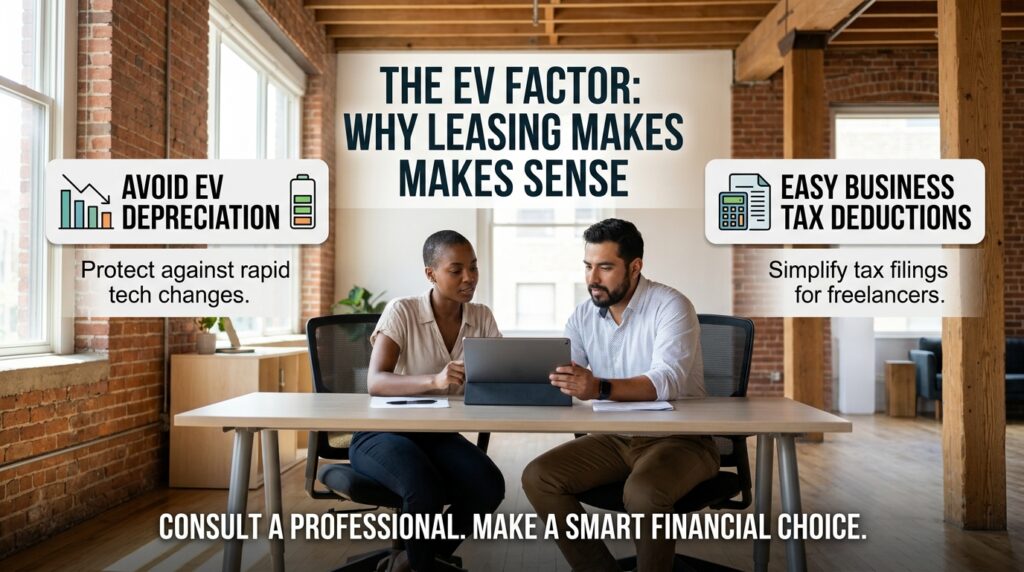
We also have to talk about the “EV Factor.” Electric vehicles are currently depreciating faster than internal combustion cars because battery tech is improving so quickly. If you are buying an EV today, leasing might actually be the safer financial play. It protects you from a sudden drop in resale value if a “breakthrough” battery is released next year.
Furthermore, consider the tax implications. If you use your car for business, lease payments are often easier to deduct as a business expense compared to the complex depreciation schedules required for a financed vehicle. Consult with a professional, but for many freelancers and business owners, the “tax save” makes leasing a slam dunk.
Conclusion
At the end of the day, the battle of Leasing vs Financing: Which One Saves You More Money Today? comes down to your personal “break-even” point. If you trade in your car every three years, financing is usually a losing battle against depreciation, and leasing will save you more in cash flow. If you are the type of person who maintains a vehicle meticulously and keeps it for the long haul, financing is the foundation of long-term wealth building.
Before you sign that stack of papers, take a breath and look at your calendar. Where do you see yourself in five years? If you see yourself driving the same car with a “Paid in Full” title in the glovebox, go find a great financing rate. If you see yourself wanting the newest 2029 model with features we haven’t even dreamed of yet, go for the lease. Both are valid tools—just make sure you’re using the one that fits your specific financial workshop. Safe driving!