
The eternal debate of choosing between a brand-new vehicle and a pre-owned gem has taken some fascinating turns as we navigate the landscape of 2026. If you’ve spent any time lately scrolling through dealership inventories or checking your credit union’s latest rates, you’ve likely noticed that the old “common sense” rules of car buying have been completely rewritten. It used to be a simple math problem: new cars were for those who wanted peace of mind, while used cars were for the bargain hunters. Today, with the rapid integration of advanced software in vehicles and a credit market that has become incredibly surgical, the decision is much more nuanced.
Finding the “smarter” financial move isn’t just about the sticker price anymore; it’s about how that price interacts with your loan term, your insurance premiums, and the car’s projected value in a world moving toward total electrification. Whether you’re eyeing a zero-mileage Electric Vehicle (EV) with all the latest sensors or a three-year-old reliable hybrid, the way you finance that purchase will dictate your financial freedom for years to come. Let’s break down the mechanics of new vs used car financing to see which path actually leaves more money in your pocket today.
The Reality of New Car Financing
When you step into a showroom in 2026, you aren’t just buying a car; you’re buying a technology suite. Manufacturers are currently in an aggressive race to move new inventory, especially as battery technology improves. This competitive environment has created some unique advantages for those looking at new car financing.
The Power of Subvented Rates
One of the biggest “wins” for new car buyers is the access to manufacturer-backed financing. Because automakers have a vested interest in moving new units off the lot, they often offer “subvented” interest rates—think 0.9%, 1.9%, or even 0% in some promotional windows. Even if a used car is cheaper, a significantly lower interest rate on a new car can sometimes bridge the gap, making the monthly payment surprisingly comparable.

Warranty and Maintenance Savings
New car financing often comes bundled with a “worry-free” period. In 2026, many brands have extended their bumper-to-bumper warranties to five or even seven years. When you finance a new car, you are essentially locking in your transportation costs. Aside from the loan payment and insurance, your out-of-pocket expenses for mechanical failures are virtually zero. For a family on a strict budget, this predictability is a form of financial security that is hard to put a price on.
The Depreciation Hurdle
We can’t talk about new cars without mentioning the “drive-off-the-lot” drop. While supply chain stabilizations have made this less drastic than in previous years, a new car still loses a chunk of its value the moment the title is signed. If you finance with a small down payment, you run the risk of being “underwater”—owing the bank more than the car is worth—for the first two or three years of the loan.
The Case for Used Car Financing
Used car financing has long been the champion of the “smart money” crowd, and for good reason. By letting someone else take the initial hit of depreciation, you can often get a much higher-tier vehicle for a fraction of its original cost.
Lower Principal, Lower Risk
The most obvious advantage is that you are borrowing less money. Borrowing $25,000 for a high-quality used sedan is inherently less risky than borrowing $45,000 for its new equivalent. Even if the interest rate is two or three points higher on the used loan, the total interest paid in dollars might still be lower because the principal amount is so much smaller.
Insurance and Registration Benefits
Financing costs aren’t the only thing that drops with a used car. Insurance companies generally charge lower premiums for older vehicles because they cost less to replace. In many regions, vehicle registration fees are also based on the car’s current value or age. These “hidden” savings can add up to hundreds of dollars a year, effectively subsidizing your loan payment.
The “Certified Pre-Owned” (CPO) Middle Ground
In 2026, the CPO market is the strongest it’s ever been. These cars undergo rigorous inspections and come with manufacturer-backed warranties that often rival new car coverage. Financing a CPO vehicle often gives you the “best of both worlds”—a lower purchase price with a more competitive interest rate than a standard used car loan.
Direct Comparison: The Math Behind the Decision
To understand what’s smarter, we have to look at the Total Cost of Ownership (TCO). Let’s compare a new $40,000 car with a 3-year-old version of the same model for $28,000.
New Car Financing (60 months)
-
Interest Rate: 2.9% (Promo rate)
-
Monthly Payment: ~$717
-
Total Interest Paid: ~$3,020
-
Total Cost over 5 years: $43,020
Used Car Financing (60 months)
-
Interest Rate: 6.5% (Standard used rate)
-
Monthly Payment: ~$548
-
Total Interest Paid: ~$4,880
-
Total Cost over 5 years: $32,880
In this scenario, the used car saves you $169 per month and over $10,000 in total. However, the new car buyer has 5 years of warranty, whereas the used car buyer might face a $2,000 repair bill in year four. Even with repairs, the used car usually wins the “pure math” battle, but the gap is narrower than most people realize once interest and maintenance are factored in.
Is it worth it?
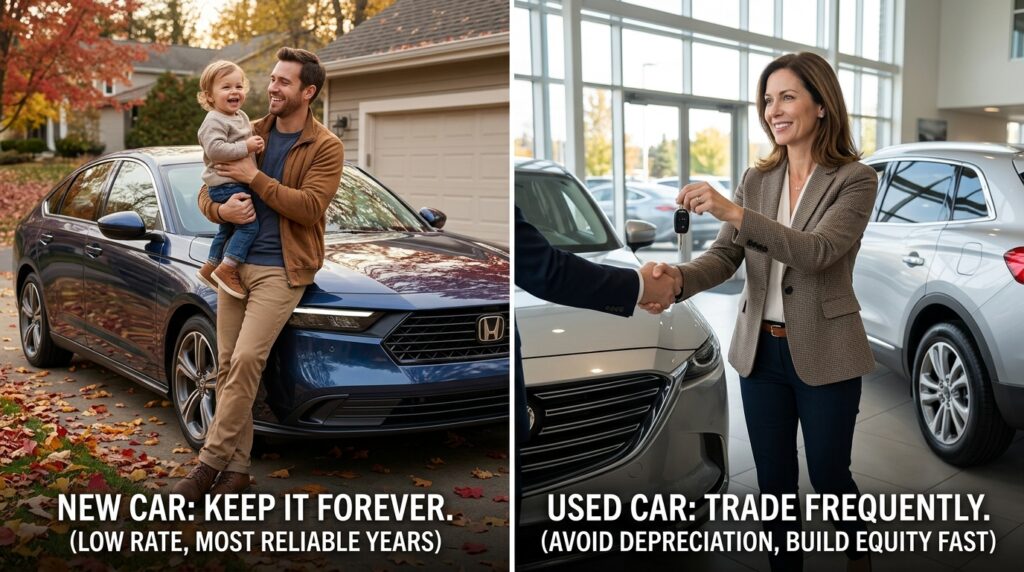
Is new car financing “worth it” in 2026? It depends on your timeline. If you plan to drive the car into the ground—keeping it for 10 or 12 years—the initial depreciation doesn’t matter. Financing a new car at a low rate and keeping it forever is one of the smartest ways to own a vehicle. You get the most reliable years of the car’s life for a very low cost of capital.
Conversely, is used car financing worth it if you trade in every few years? Absolutely. Because you avoided the massive first-year depreciation hit, you’ll have a much easier time reaching “equity” in the loan, allowing you to trade the car in without owing the bank extra money.
What to consider before choosing
Before you pull the trigger on a loan, ask yourself these crucial questions for the 2026 market:
What is the “Spread” on Interest Rates? Check your local credit union. If the gap between a new car loan (4%) and a used car loan (9%) is huge, the used car becomes much more expensive to finance. Sometimes, a “cheaper” used car can end up costing nearly the same monthly as a new one if the interest rates are lopsided.
How is the Tech Life Cycle? In 2026, car tech is moving at lightning speed. A 2023 used car might lack the autonomous safety features or the battery range that became standard in 2026. If you’re financing for 60 or 72 months, make sure you won’t feel like you’re driving a “dinosaur” halfway through your loan.
Are there Federal or Local Incentives? Many 2026 tax credits for EVs and hybrids only apply to new car purchases. If you can get a $7,500 credit on a new car, it might actually make the new car cheaper than a two-year-old used version of the same model.
Important tips
To navigate the New vs Used Car Financing maze like a pro, keep these tips in mind:
-
Get a “Blank Check” Pre-approval: Before you go to the dealer, get pre-approved for both a new and used car loan from your bank. This tells you exactly what your interest rate “ceiling” is and gives you a powerful negotiating tool.
-
Look at the “Residual” Value: Research what the car will be worth in five years. Some brands hold their value incredibly well (making them great for new car financing), while others plummet (making them incredible bargains for used car buyers).
-
Check the “Out-the-Door” Price: New car dealers often add “destination fees” and “dealer prep” costs that aren’t on used cars. Always compare the final, total price, not just the sticker.
-
Mind the Loan Term: Don’t use a 72 or 84-month loan just to make a new car “affordable.” If you need 7 years to pay for it, you’re better off financing a used car for 48 months.
The 2026 EV Factor
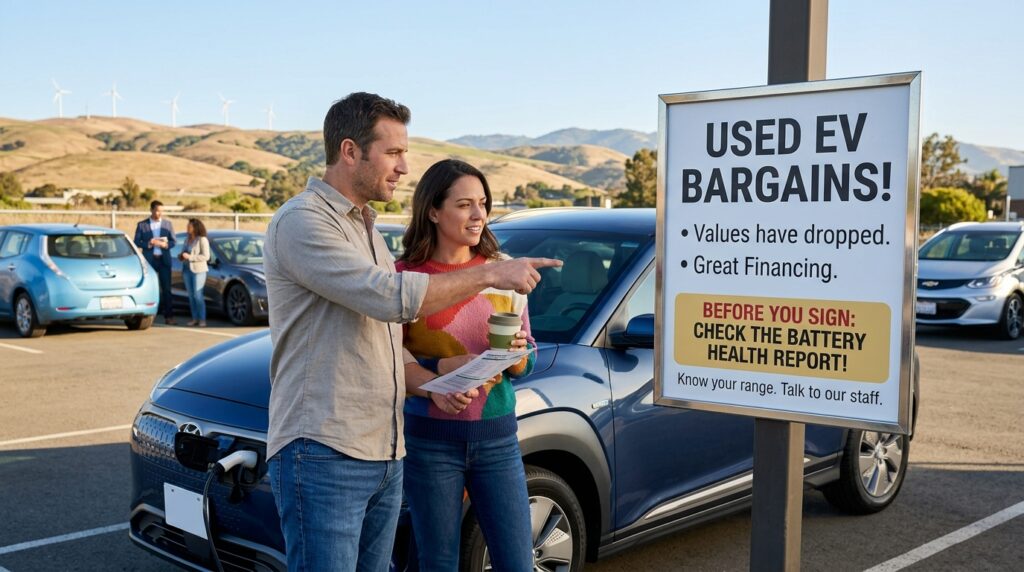
We have to address the “Electric Elephant” in the room. Electric vehicles are currently depreciating differently than gas cars. Because battery tech is evolving so fast, used EVs are often significantly cheaper to finance because their resale value is lower. However, new EVs often have much better charging speeds and range. If you are financing an EV, the used market offers staggering bargains right now, but you must check the “battery health” report before signing anything.
Conclusion
So, what’s smarter in 2026? If you are looking for the absolute lowest total outlay and you are comfortable with a little bit of mechanical uncertainty, Used Car Financing is still the champion of the frugal. It allows you to sidestep the steepest part of the depreciation curve and keeps your insurance and registration costs in check.
However, if you value a fixed monthly cost, the latest safety technology, and access to ultra-low interest rates, New Car Financing is far from a “waste of money.” In fact, for someone who keeps their vehicle for a decade, it is often the more serene and predictable path to car ownership.
The “smarter” move is the one that aligns with your cash flow and your risk tolerance. Take the time to run the numbers on both, consider the tax credits, and don’t forget to factor in the cost of a warranty. Whether it’s that “new car smell” or the satisfaction of a used car bargain, make sure the financing behind it is as solid as the vehicle itself. Safe travels on your car-buying journey!