
We have all been there. You walk onto a dealership lot just “to look,” and within twenty minutes, a charismatic salesperson has you sitting in the driver’s seat of a premium SUV that smells like Italian leather and success. Your brain starts playing a dangerous game of “monthly payment math,” trying to justify how skipping a few dinners out could make that $800-a-month note disappear into your budget. But here is the cold, hard truth: the sticker price is just the tip of the iceberg. If you don’t have a strategy, that beautiful machine in your driveway can quickly turn into a financial anchor that keeps you from ever reaching your bigger life goals.
In the economic landscape of April 2026, learning How to Choose a Car You Can Actually Afford is more critical than ever. Interest rates have stabilized, but they aren’t exactly “cheap,” and the sheer amount of technology packed into modern vehicles means that even a “budget” car carries a premium price tag. Affordability isn’t just about whether the bank will give you the loan—banks are surprisingly willing to let you overextend yourself. Real affordability is about “Total Cost of Ownership” (TCO). It’s about insurance, fuel, maintenance, and that silent killer called depreciation. Let’s strip away the marketing fluff and look at the actual mechanics of buying a car that fits your life without draining your soul.
The 20/4/10 Rule: Your Financial North Star
If you want a simple, battle-tested formula to keep you out of trouble, the “20/4/10” rule is your best friend. It’s an old-school piece of advice that has regained massive relevance in 2026 as car prices have climbed. Here is how it breaks down: Put 20% down, finance for no more than 4 years (48 months), and ensure your total automotive costs (loan, insurance, fuel) don’t exceed 10% of your gross monthly income.
Why is this so powerful? Putting 20% down ensures you aren’t “underwater” (owing more than the car is worth) the moment you drive off the lot. Keeping the loan to 4 years prevents you from paying thousands in interest on a car that is long out of warranty. And the 10% cap ensures you still have money for the things that actually matter—like your retirement, your kids’ education, or that vacation you’ve been putting off. When you follow this rule, you aren’t just buying a car; you’re buying financial peace of mind.

The Hidden Cost of the “Monthly Payment” Trap
Dealerships love to ask one specific question: “What monthly payment are you looking for?” It sounds helpful, but it is a psychological trap. If you tell them you can afford $500 a month, they can make almost any car fit that number by stretching the loan to 72 or even 84 months. In 2026, an 84-month loan is a recipe for disaster. By year six, you are making a high payment on a car that likely needs new tires, a battery, and major scheduled maintenance, all while the car’s resale value is plummeting.
When you are learning How to Choose a Car You Can Actually Afford, you must ignore the monthly payment until the very end. Focus on the “Out-the-Door” price. This includes the car, the taxes, the registration, and those pesky dealer fees. If the total price is $35,000, that’s your reality. Don’t let a long-term loan disguise a price tag that is actually too high for your current net worth. If you can’t afford the car on a 48-month or 60-month term, you simply can’t afford the car.
Real-World Scenario: The “Reliable” vs. The “Luxurious”
Let’s look at a common 2026 crossroads. Imagine Sarah, who earns $75,000 a year. She is torn between a brand-new 2026 Toyota RAV4 Hybrid and a used 2023 BMW X3.
The BMW has a lower sticker price because it’s three years old, and the monthly payment looks identical to the Toyota. However, the BMW requires premium fuel, its insurance premiums are 40% higher due to parts costs, and it’s about to hit a major service interval that costs $1,500. The Toyota, while “boring” to some, offers a lower interest rate because it’s new, gets 40 MPG, and comes with two years of free maintenance.
By the end of the first year, the “cheaper” BMW will have cost Sarah $3,000 more than the Toyota. This is the essence of How to Choose a Car You Can Actually Afford. You have to look at the car as a multi-year service, not just a one-time purchase.
Is it worth it?
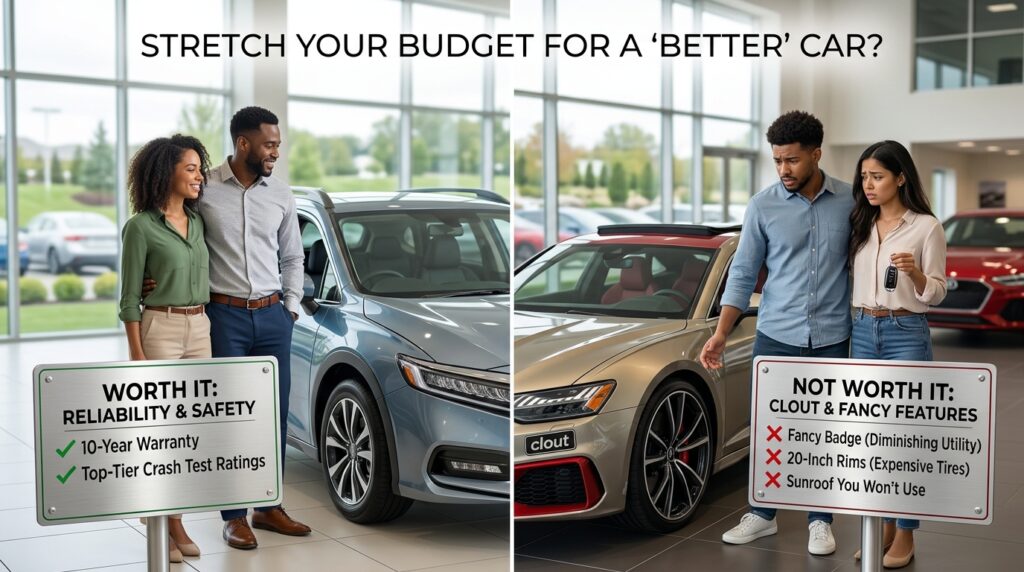
Is it worth it to stretch your budget for a “better” car? Sometimes, the answer is a cautious yes, but only if that extra money buys you reliability and safety. If spending an extra $3,000 upfront gets you a car with a 10-year warranty and top-tier crash test ratings, that is a logical investment in your future.
However, if you are stretching your budget for “clout”—for a fancy badge, a sunroof you’ll never open, or 20-inch rims that make the tires twice as expensive to replace—then no, it is absolutely not worth it. In 2026, the gap between “base” models and “luxury” models has narrowed. Most entry-level cars now come with adaptive cruise control, Apple CarPlay, and high-quality safety sensors. Paying a premium for a luxury badge often gets you diminishing returns on actual utility.
What to Consider Before You Choose
Before you sign the dotted line, you need to conduct a “Financial Audit” of your choice. Here are the three pillars you need to inspect:
1. Insurance Sticker Shock
I’ve seen buyers secure a great loan only to find out their insurance is going to be $250 a month. In 2026, insurance rates have spiked due to the high cost of repairing sensors and electric drivetrains. Before you buy, get the VIN of the car and call your agent. If the insurance pushes you over that 10% monthly income limit, the car isn’t affordable.
2. The Fuel (or Charging) Reality
Are you driving 50 miles a day? If so, the difference between a car that gets 25 MPG and one that gets 45 MPG is massive. Over a 5-year loan, a fuel-efficient car can save you $5,000 to $8,000. When calculating How to Choose a Car You Can Actually Afford, fuel should be treated as a fixed part of the “loan payment.”
3. Depreciation and Resale
Some cars are “leasing cars,” and some are “buying cars.” If you’re buying, you want something that holds its value. Financing a car that loses 60% of its value in three years (looking at you, luxury executive sedans) is the fastest way to stay broke. Stick to brands with high residual values like Toyota, Honda, Subaru, or Tesla. This ensures that when you’re ready to move on, you actually have equity to put toward your next vehicle.
Important Tips
-
The “Wait 48 Hours” Rule: Never buy a car the same day you see it. Go home. Look at your spreadsheets. Sleep on it. The “new car smell” wears off in a few months, but the debt lasts for years.
-
Factor in the “Misc” Fund: Set aside $100 a month into a separate savings account for “Car Chaos”—new tires, unexpected repairs, or an insurance deductible. If you can’t afford to save that $100, you can’t afford the car.
-
Buy at the End of the Quarter: In March, June, September, and December, dealers are desperate to hit their quotas. You can often shave $1,000 to $2,000 off the price just by being the person who helps them hit their goal.
-
Get Pre-Approved: Walking into a dealer with a pre-approval from a credit union changes the power dynamic. You are no longer “asking” for a deal; you are “shopping” with cash in hand.
The Psychology of Ownership vs. Appearance
There is a huge difference between looking like you have money and actually having money. In our social-media-driven world, the pressure to drive something impressive is real. But there is a specific kind of confidence that comes from driving a five-year-old, paid-off Honda Civic while your bank account grows every month.
When you truly understand How to Choose a Car You Can Actually Afford, you stop viewing the car as a status symbol and start viewing it as a tool. A tool’s job is to be reliable, safe, and cost-effective. If your car is causing you stress every time the rent is due or every time you want to go out with friends, it’s not a tool—it’s a burden. Choose the car that lets you breathe.

Conclusion: Driving Your Financial Future
At the end of the day, How to Choose a Car You Can Actually Afford is about values. Do you value the temporary thrill of a luxury interior, or do you value the long-term freedom of financial stability?
Take your time. Use the 20/4/10 rule as your guide. Research the total cost of ownership, call your insurance agent, and ignore the siren song of the 84-month loan. If you do the math upfront, you’ll never have to worry about the math down the road.
A car should be a gateway to your life’s adventures, not the reason you can’t afford them. By being the “smartest person in the room” at the dealership, you aren’t just getting a better ride—you’re ensuring that your financial future stays exactly where it belongs: in your hands. Happy (and responsible) car hunting!