
So, you’re standing on the dealership lot, staring at that shiny new SUV, and the salesperson asks the million-dollar question: “Are we looking to lease this, or are you thinking about traditional financing?” It’s a fork in the road that every car buyer hits, and honestly, it’s where most people start to feel the headache coming on. It’s not just about the monthly payment; it’s about what your life looks like three, five, or even ten years down the line. We all want the best deal, but “best” is a relative term in the world of automotive math.
Buying a car is one of the biggest financial moves you’ll make, second only to housing for most of us. Yet, the terminology—residuals, money factors, APR, depreciation—can make it feel like you’re trying to solve a high-level physics equation just to get to work in the morning. Let’s strip away the jargon and look at the actual numbers. By the time we’re done, you’ll see exactly where your money goes in both scenarios, helping you decide which path actually fits your wallet and your lifestyle.
The Core Philosophy: Ownership vs. Usage
Before we crunch the numbers, we have to talk about the “vibe” of each choice. Financing is the path of the Owner. You are buying an asset. Yes, it’s a depreciating asset (it loses value the moment you drive away), but eventually, the payments stop. You own the metal. You can paint it neon green, drive it across the country, or sell it to your neighbor whenever you want.
Leasing, on the other hand, is the path of the User. You aren’t buying the car; you are paying for the privilege of using it during its “prime years.” You’re essentially paying for the portion of the car’s value that you “use up” while it’s in your driveway. When the three years are up, you hand back the keys and walk away—or start over with a new one.

The Mechanics of a Lease
When you lease, the bank calculates what the car will be worth in three years (the residual value). If a $40,000 car is expected to be worth $24,000 in three years, your lease payments cover that $16,000 difference, plus interest (the money factor) and taxes. This is why lease payments are almost always lower than financing payments; you aren’t paying for the whole car, just the “slice” you’re using.
The Mechanics of Financing
With a loan, you are borrowing the full $40,000 (minus your down payment). You pay back the principal plus interest over a set term, usually 60 or 72 months. Because you’re paying for the 100% of the vehicle, the monthly bite is bigger, but the end goal is a $0 balance and a title in your name.
Real Numbers: A $45,000 Simulation
Let’s look at a realistic comparison. Imagine you are eyeing a mid-size sedan or a compact SUV with a sticker price of $45,000. We will assume you have a solid credit score and a $5,000 down payment (or trade-in).
Scenario A: The 60-Month Finance Deal
-
Vehicle Price: $45,000
-
Down Payment: $5,000
-
Amount Financed: $40,000
-
Interest Rate (APR): 6%
-
Monthly Payment: ~$773
-
Total Interest Paid: ~$6,400
-
Total Cost after 5 Years: $51,400
At the end of year five, you own a car that is likely worth about $18,000 to $20,000. You have no more payments. Your monthly “transportation cost” effectively drops to just insurance and maintenance.
Scenario B: The 36-Month Lease
-
Vehicle Price: $45,000
-
Down Payment: $5,000 (often called “Capitalized Cost Reduction”)
-
Residual Value (55%): $24,750
-
Rent Charge (Interest): Equivalent to 6%
-
Monthly Payment: ~$545
-
Total Cost after 3 Years: $24,620
After three years, you have spent nearly $25,000, and you have zero equity. If you want to keep driving, you have to go back to the dealership and start a new lease or buy a car. If you do another 3-year lease at the same price, your total 6-year spend would be roughly $49,000, and you’d still own nothing.
The Hidden Costs: Beyond the Monthly Bill
Numbers on a spreadsheet don’t tell the whole story. Life happens between the payments, and this is where the “real” cost breakdown gets interesting.
Maintenance and Repairs
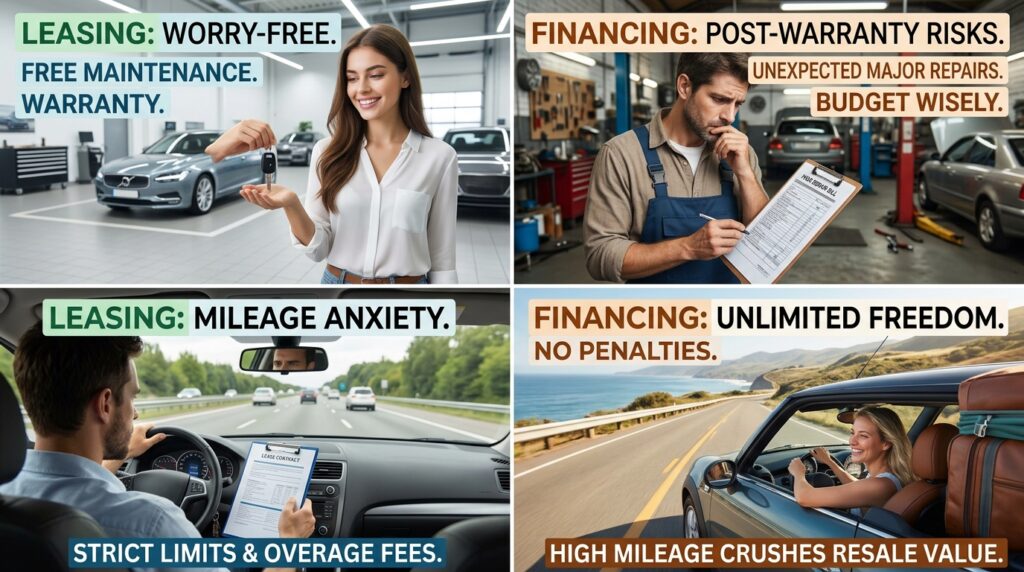
When you lease, you are almost always under the manufacturer’s bumper-to-bumper warranty for the entire duration of the contract. Many brands even throw in free oil changes and tire rotations. Your “surprise repair cost” is essentially zero.
When you finance for five or six years, you will eventually hit the “out of warranty” zone. Suddenly, that $800 alternator or $1,200 brake job is your problem. If you plan to keep the car for ten years, these costs are just part of the game, but they are a factor you must budget for.
The Mileage Trap
Leases come with boundaries. The most common is 12,000 miles per year. If you have a long commute or love spontaneous road trips, you might find yourself hovering over the odometer with anxiety. Over-mileage fees can range from $0.15 to $0.30 per mile. If you go 5,000 miles over, that’s a $1,000 to $1,500 bill waiting for you at the end.
If you finance, the miles don’t matter in terms of “penalties,” but high mileage will crush your resale value. Either way, you pay for the distance you travel; it’s just a matter of whether you pay the bank at the end or lose money when you eventually sell it.
Is Leasing Actually “Throwing Money Away”?
You’ve probably heard your parents or a frugal friend say, “Leasing is just renting; you’re throwing money away.” While that’s a popular sentiment, it’s a bit of an oversimplification.
Think of it like a subscription service. Is Netflix “throwing money away” because you don’t own the DVD? Not necessarily. You are paying for the service of entertainment. Leasing is paying for the “service” of a reliable, modern vehicle without the long-term risk of ownership.
When Leasing Wins
-
Business Owners: If you use your car for work, lease payments are often easier to deduct as a business expense than depreciation schedules on a purchase.
-
Technology Fans: Cars are becoming like smartphones. The safety tech and infotainment in a 2026 model are vastly superior to a 2021 model. If you love having the latest gadgets, leasing keeps you in the loop.
-
Cash Flow Seekers: If saving $200 a month on your payment allows you to invest that money elsewhere (like a high-yield savings account or the stock market), the “lost equity” might be offset by your investment gains.
When Financing Wins
-
The Long-Haul Driver: If you plan to drive the car until the wheels fall off (7–10 years), financing is the undisputed champion. The “sweet spot” of car ownership is years 6 through 10, when the car is paid off but still runs well.
-
The Customizer: If you want to add a lift kit, a better sound system, or even just a specific window tint, you need to own the car. Leasing companies want the car back in “stock” condition.
-
The High-Mileage Commuter: If you’re doing 20,000 miles a year, a lease will eat you alive in fees.
The “End of Lease” Decision Matrix
One of the coolest (and most confusing) parts of leasing is the “Lease-End Purchase Option.” At the start of your lease, the bank guesses what the car will be worth (the residual). Sometimes they guess wrong.
If the bank said your car would be worth $25,000, but because of market shortages, it’s actually worth $28,000, you have “equity” in a lease! You can buy the car for the pre-set $25,000 and immediately sell it for a profit, or keep it.
Conversely, if the car is worth only $20,000 because it was in a minor accident or the model became unpopular, you just hand it back. The bank takes the $5,000 loss, not you. This “downside protection” is a massive, often overlooked benefit of leasing.
Practical Tips for Your Next Deal
-
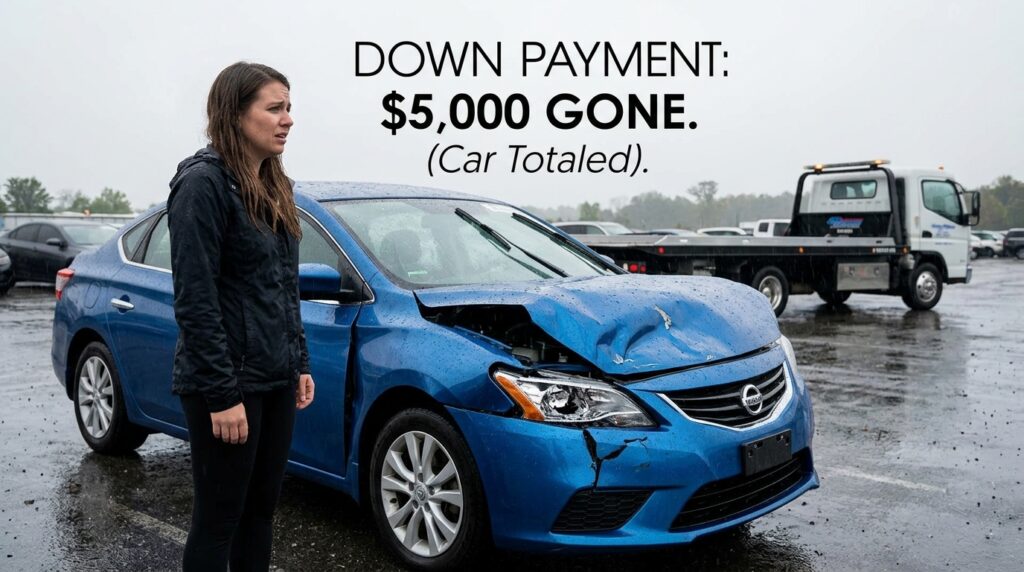
Don’t Put Too Much Down on a Lease: If you put $5,000 down on a lease and the car is totaled in a wreck three months later, that $5,000 is usually gone. The insurance pays the leasing company, not you. It’s better to keep your cash in a savings account and pay a slightly higher monthly fee.
-
Negotiate the Price, Not the Payment: Whether leasing or financing, the “sale price” of the car matters. Dealerships love to hide high prices inside “affordable” monthly payments. Always agree on the total cost of the vehicle first.
-
Check the “Money Factor”: In leasing, interest isn’t called APR; it’s the “money factor.” To see the equivalent APR, multiply the money factor by 2,400. If they give you a factor of 0.0025, that’s 6% interest. Knowing this keeps you from getting ripped off.
Conclusion: Making the Choice
At the end of the day, the Leasing vs Financing Cost Breakdown isn’t just about who pays less—it’s about how you value your money and your time.
If you view a car as a tool that should eventually be paid off so you can enjoy a life without car payments, financing is your best bet. It requires more cash upfront and higher monthly commitment, but it builds wealth over the long term through equity.
However, if you view a car as a monthly utility—like your internet or electricity bill—and you value reliability, warranty coverage, and the latest safety features above all else, leasing is a sophisticated way to manage your transportation. It keeps your monthly costs predictable and your garage filled with modern technology.
Take a look at your bank account, check your annual mileage, and be honest about how long you really want to keep that car. There is no wrong answer, only the answer that lets you sleep better at night. Happy driving!