
For many car buyers, 2026 feels like the year the “electric dream” finally became a practical financial reality. The early adopter phase is over, and we have entered a season where manufacturers are prioritizing volume over exclusivity. If you’ve been sitting on the sidelines waiting for the right moment to switch from gasoline to electrons, the current financing landscape suggests your patience might be about to pay off.
In 2026, “smart buying” isn’t just about the lowest sticker price; it’s about navigating a market where interest rates are stabilizing, inventory is plentiful, and manufacturers are using aggressive financing to maintain their market share. Whether you’re looking for a family hauler or a daily commuter, here is how to navigate the best electric car financing deals available right now.
The 0% APR Resurgence: Manufacturers Are Competing for Your Loan
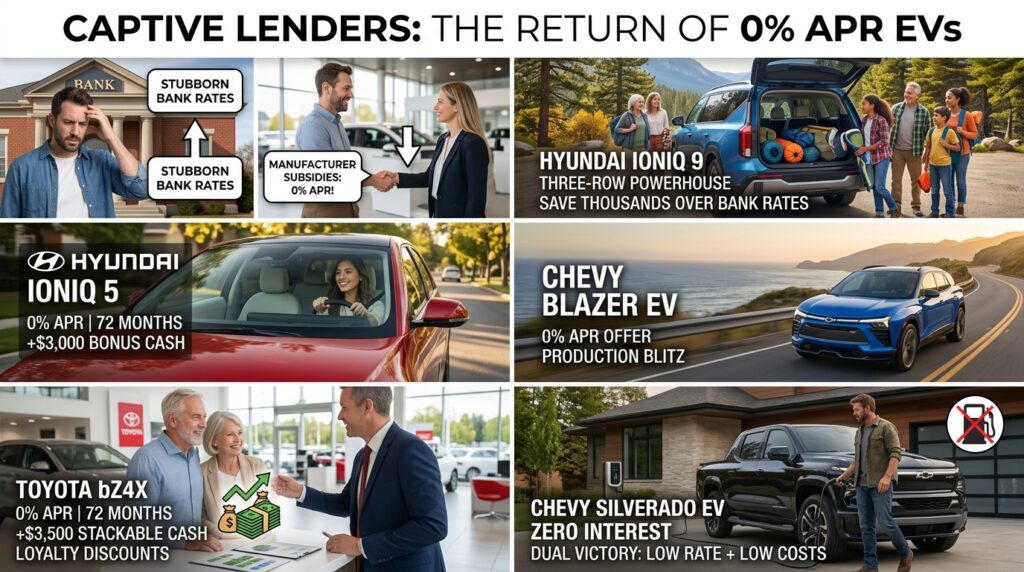
While traditional bank rates for auto loans remain stubborn, captive lenders—the financing arms of the car companies themselves—are stepping in with massive subsidies. For the first time in several years, we are seeing the return of the 0% APR offer on flagship electric models.
1. Hyundai IONIQ 5 and IONIQ 9
Hyundai has positioned itself as the aggressive leader in the 2026 EV market. Currently, the IONIQ 5 is seeing nationwide offers of 0% APR for up to 72 months, often paired with “bonus cash” incentives that can reach as high as $3,000.
For larger families, the newly released IONIQ 9—a three-row powerhouse—is being launched with introductory rates that undercut almost every luxury competitor. By financing through Hyundai Motor Finance, you are effectively letting the manufacturer pay the interest that would otherwise go to a bank, potentially saving you $5,000 to $8,000 over the life of the loan compared to a standard 7.5% rate.
2. Toyota bZ4X
Toyota took a slower approach to EVs, but they are making up for lost time with some of the most “stackable” deals in the industry. In many regions, the 2026 Toyota bZ4X is available with 0% APR for 72 months plus $3,500 in APR cash.
If you are a returning Toyota customer, you might even qualify for additional loyalty discounts. While the bZ4X faced early criticism for its range, the 2026 updates have smoothed out those edges, making it a very logical, low-cost financing play for those who trust the Toyota badge.
3. Chevrolet Blazer EV and Silverado EV
General Motors is in a “production blitz” phase. To move units, they are offering 0% APR on the Blazer EV and highly competitive rates on the Silverado EV. For truck buyers who are tired of $100 fill-ups at the gas station, financing a Silverado EV at a low rate offers a dual victory: zero interest and significantly lower operating costs per mile.
The “Residual Value” Strategy: Financing for the Long Haul
A common fear with EVs is rapid depreciation. As battery technology improves, older models can lose value quickly. However, by 2026, certain models have proven their “staying power.” If you plan to finance a car and keep it for 7 to 10 years, you want a vehicle that will still be desirable (and functional) a decade from now.
Tesla Model Y: The Safe Bet
The Tesla Model Y remains the most popular EV on the planet for a reason. Because of its massive sales volume, the ecosystem for repairs, software updates, and third-party accessories is unmatched.
When you finance a Model Y, you are betting on a vehicle that stays “fresh” through over-the-air updates. Even with higher interest rates compared to some zero-percent competitors, the Model Y’s resale value often makes it a smarter financial move in the long run. If you owe $30,000 on a car that is worth $28,000, you are in a much better position than someone who owes $20,000 on a car worth $12,000.
Kia EV9: The Three-Row Game Changer
The Kia EV9 is currently the “it” car for suburban families. It offers the utility of a Telluride with a world-class electric powertrain. Kia is supporting the EV9 with competitive financing rates (often around 0.9% to 1.9%) and a 10-year warranty that covers the battery and drive units. Financing a vehicle with this level of warranty protection is a smart way to “cap” your potential long-term expenses.
New vs. Used: The 2026 Dilemma
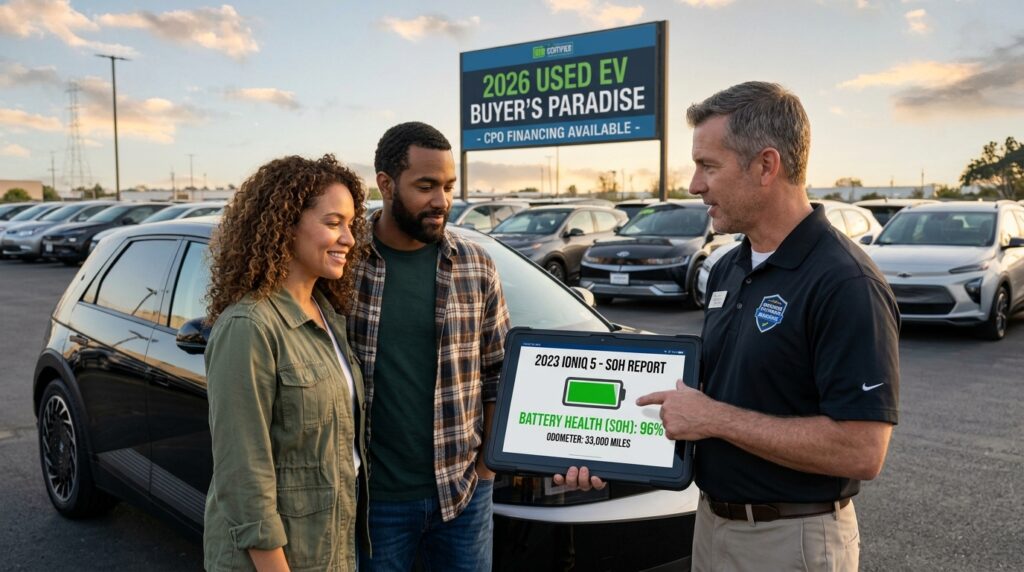
One of the most interesting shifts in 2026 is the flood of three-year-old EVs hitting the used market as lease returns from 2023. This has created a “buyer’s paradise” for those looking to finance a pre-owned vehicle.
The Used EV Financing Advantage
Many 2023 and 2024 models are now available for under $25,000. While used car interest rates are generally higher than new car rates, the lower principal amount often results in a smaller monthly payment.
-
Tip: Look for Certified Pre-Owned (CPO) electric cars. CPO programs often come with special subsidized interest rates from the manufacturer that are much lower than what your local credit union can offer on a standard used car.
Battery Health is the New Mileage
When financing a used EV in 2026, your primary concern shouldn’t be the odometer—it should be the SOH (State of Health) of the battery. Use tools like Recurrent or ask for a dealer battery report before signing. Financing a car with 95% battery health is a smart buy; financing one at 80% is a risk, regardless of the interest rate.
How to Maximize Your EV Finance Deal
To get the best possible terms in 2026, you need to look beyond the monthly payment. Here is a checklist for the savvy borrower:
1. Check for “Hidden” Rebates
In 2026, federal tax credits have evolved, and many are now “point-of-sale” rebates. This means you can often use the $7,500 credit (if you qualify) as a down payment provided by the government. This immediately lowers your “LTV” (Loan-to-Value) ratio, which can help you secure a lower interest rate from the lender.
2. Shorten the Term if Possible
While 72-month and 84-month loans are tempting because they lower the monthly payment, they are a trap for EVs. Because technology moves fast, you don’t want to be paying for a 2026 car in 2033 when solid-state batteries might be the new norm. Aim for 48 or 60 months to ensure you stay “above water” on the loan.
3. Consider the Total Cost of Ownership (TCO)
When the finance manager asks if you can afford a $600/month payment, remind yourself that a $600 EV payment is not the same as a $600 gas car payment. Without oil changes and with significantly lower “fuel” costs, a higher monthly loan payment on an EV can actually leave more money in your pocket at the end of the month than a cheaper gas car.
The Red Flags: What to Avoid Financing
Not every electric car is a good financial candidate. Avoid these common pitfalls:
-
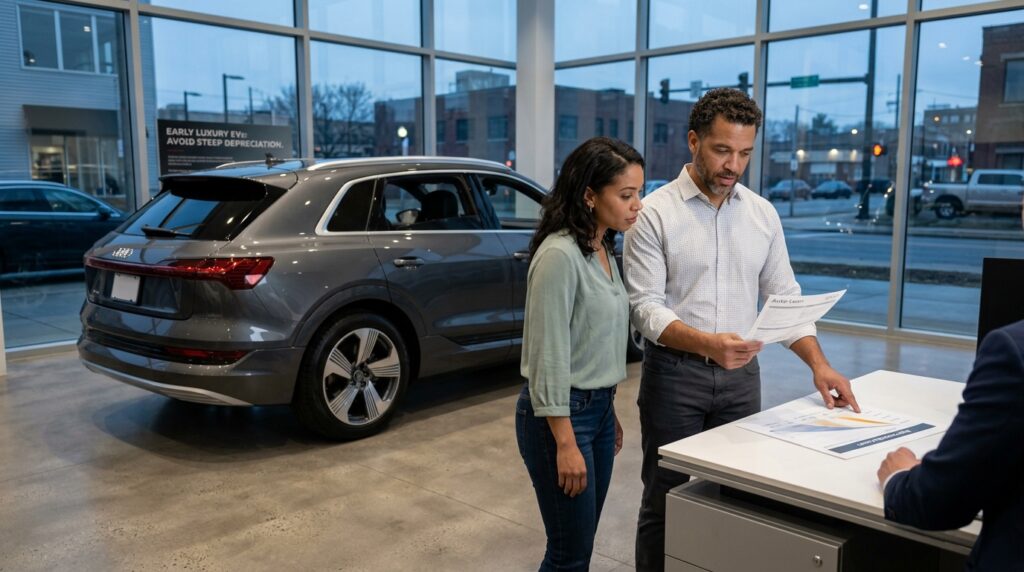
Early-Generation Luxury EVs: Avoid financing older, high-end luxury EVs (like early Audi e-trons or Jaguar I-Paces) unless you have a massive down payment. Their depreciation curves are notoriously steep.
-
Financing the Home Charger: Many dealers will offer to roll the cost of a home charger and installation (often $1,500–$2,500) into your auto loan. While convenient, you are then paying interest on that hardware for 5+ years. It’s almost always cheaper to pay for the charger upfront or use a separate home improvement line of credit.
-
Non-LFP Batteries for High Mileage: If you plan to put 20,000 miles a year on the car, try to finance a model with an LFP (Lithium Iron Phosphate) battery. They handle daily 100% charging much better than nickel-based batteries, ensuring your collateral (the car) stays valuable longer.
Final Thoughts
Financing an electric car in 2026 is less about “saving the planet” and more about “saving your budget.” With manufacturers like Hyundai, Toyota, and Chevrolet offering zero-interest deals to move their growing inventory, the financial friction of going electric has largely vanished.
The smartest move right now is to find a manufacturer-subsidized APR deal, apply the federal point-of-sale rebate as your down payment, and choose a model with a proven track record of reliability. If you do that, you aren’t just buying a car—you’re making a high-tech financial investment that will pay dividends every time you drive past a gas station.