
In the high-stakes world of car shopping in 2026, the “new car smell” has become an expensive luxury. With the average price of a brand-new vehicle hovering at record highs, savvy buyers are increasingly turning toward the secondary market. However, this is where the road splits: do you go for a Certified Pre-Owned (CPO) vehicle or a traditional Used Car?
The choice isn’t just about the price tag on the windshield. It’s about risk tolerance, financing math, and how much you value your sleep at night. While both options involve a car that has had a previous owner, the mechanical and financial structures behind them are worlds apart.
Let’s break down the reality of CPO vs. used cars so you can decide which path fits your budget and your lifestyle.
What Exactly Is a Certified Pre-Owned (CPO) Car?
A CPO car is essentially the “elite” tier of the used car world. These aren’t just any trade-ins found on the back of a lot. To be certified, a car must meet strict criteria set by the original manufacturer (like Toyota, Ford, or BMW).
Typically, a CPO vehicle must be under a certain age (usually less than 5–6 years old) and have a mileage cap (often under 60,000 or 75,000 miles). If the car meets these basic requirements, it undergoes a rigorous multi-point inspection—sometimes up to 160 or 200 individual checks—performed by factory-trained technicians.
The Manufacturer’s Seal of Approval
The biggest differentiator for a CPO car is the warranty. Unlike a standard used car, which might only have whatever is left of the original factory warranty, a CPO vehicle comes with an extended warranty backed by the manufacturer.
This means you can take a CPO Honda to any Honda dealership in the country for a covered repair. It’s a “safety net” that mirrors the experience of buying a new car, but at a significantly lower entry price.

The Traditional Used Car: The Wild West of Value
A standard used car is exactly what it sounds like. It could be a three-year-old lease return, or it could be a fifteen-year-old sedan with 150,000 miles. These cars are sold “as-is” or with a very limited, short-term dealer warranty.
When you buy a traditional used car, the responsibility of due diligence falls entirely on you. The dealership might have washed it and changed the oil, but there is no corporate-mandated 160-point inspection requirement.
Why People Still Choose “Used”
The primary driver here is the price. Without the costs of the inspection, the certification fee paid to the manufacturer, and the extended warranty, a standard used car will almost always be cheaper than its CPO counterpart—sometimes by several thousand dollars. For the budget-conscious buyer, this price gap represents a lot of gasoline and insurance payments.
The Hidden Math: CPO Financing vs. Used Car Rates
One of the most overlooked aspects of the CPO vs. Used debate is the financing. In 2026, interest rates have a massive impact on your total cost of ownership, and this is where CPO cars often pull ahead.
Subsidized Interest Rates
Because manufacturers want to build brand loyalty, they often offer “subvented” financing on CPO vehicles. It is not uncommon to see a CPO car with a 1.9% or 2.9% APR offer, while a standard used car loan at a bank might sit at 7% or 8%.
If you are financing $25,000 over 60 months, that interest rate gap can save you over $3,000. When you factor in those savings, the “more expensive” CPO car might actually have a lower monthly payment and a lower total cost than the “cheaper” used car.
Reliability and the “Peace of Mind” Tax
When you buy a CPO car, you are paying a premium—often called the “peace of mind tax.” Is it worth it?
The Rigorous Inspection Reality
In a CPO program, if a technician finds that the brake pads have only 30% life left, the manufacturer rules often require them to be replaced with brand-new OEM parts to pass certification. In the standard used car world, those 30% brakes are considered “good enough” to sell.
CPO buyers are essentially paying upfront for maintenance that a used car buyer will likely have to pay for out of pocket six months down the road. If you aren’t mechanically inclined and don’t want to worry about “surprises,” the CPO route is a strong contender.
When a Standard Used Car is the Smarter Move
Despite the perks of CPO, there are specific scenarios where a traditional used car is the undisputed winner.
1. The Older, High-Reliability Model
If you are looking at a brand known for bulletproof reliability—like a mid-2010s Toyota Corolla or a Honda Civic—paying an extra $3,000 for a CPO warranty might be overkill. These cars are famous for reaching 200,000 miles with basic maintenance. If you find a well-maintained one with a clean service history, the “certification” adds little practical value.
2. Private Party Sales
The best deals in the automotive world are often found in private driveways, not on dealer lots. When you buy from an individual, you avoid the dealership’s overhead and “doc fees.” You can use the money you saved to hire an independent mechanic for a Pre-Purchase Inspection (PPI), which gives you similar confidence to a CPO check for a fraction of the cost.

The Risk of “CPO-Lite” (Dealer-Certified)
In 2026, many independent dealerships have started offering their own “certified” programs. Be very careful here. There is a massive difference between Manufacturer Certified and Dealer Certified.
-
Manufacturer CPO: Backed by the brand (e.g., Ford). Valid at any brand dealership.
-
Dealer Certified: Backed only by that specific local dealership or a third-party insurance company. If that dealer goes out of business or if you move to another state, your warranty might be worthless.
Always ask to see the warranty paperwork. If it doesn’t have the official manufacturer logo on it, it’s not a true CPO car.
Key Questions to Ask Before You Buy
To make a truly smart purchase, you need to dig into the details. Use these questions to smoke out the truth:
-
For CPO: “Can I see the completed inspection checklist?” A reputable dealer should have no problem showing you exactly what was checked and what was repaired to meet certification standards.
-
For Used: “Is this car still under the original powertrain warranty?” Many cars have powertrain warranties (engine/transmission) that last 5 years or 60,000 miles. If the used car still has two years left, you might not need the CPO extension.
-
For Both: “Can I see the Carfax or AutoCheck report?” Never buy a used vehicle—certified or not—without seeing its accident and service history.
Depreciation: The Silent Partner
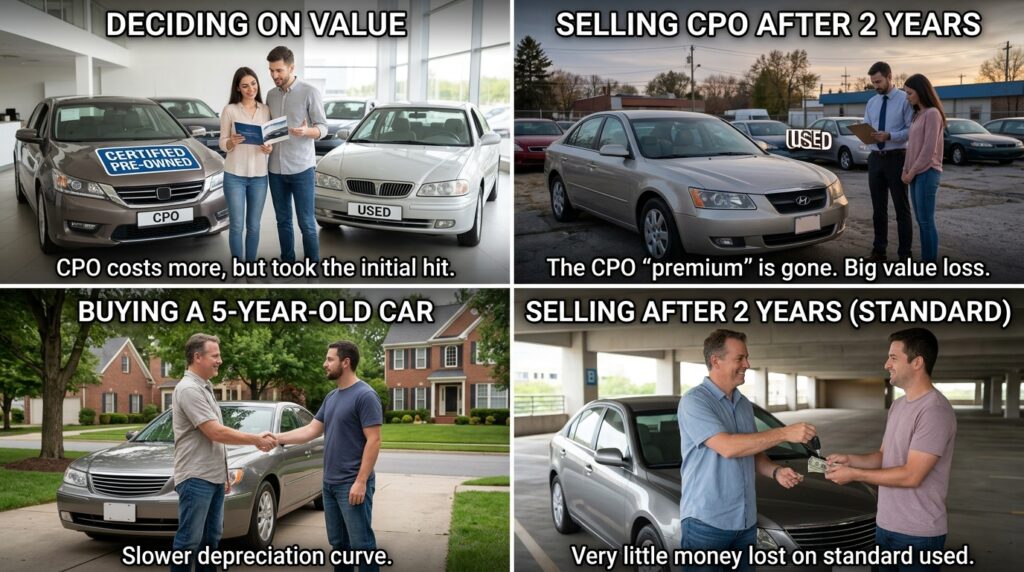
Depreciation affects CPO and used cars differently. A new car loses the most value the moment it leaves the lot. A CPO car has already taken that initial hit, but it still commands a premium price.
Standard used cars have usually settled into a slower depreciation curve. If you buy a 5-year-old used car and sell it two years later, you will likely lose very little money. If you buy a 2-year-old CPO car and sell it two years later, the “premium” you paid for the certification vanishes instantly in the used market. If you plan to trade the car in every 2 or 3 years, the standard used car is often the better financial play.
Conclusion: Which One Is Better for You?
There is no “one size fits all” answer, but there is a “best fit” for your specific situation.
Choose a Certified Pre-Owned (CPO) car if:
-
You want the latest technology and safety features but can’t justify new-car prices.
-
You are financing the vehicle and can take advantage of low CPO interest rates.
-
You want the security of a manufacturer-backed warranty.
-
You don’t want to spend time hunting for an independent mechanic.
Choose a traditional Used car if:
-
You are paying cash or have secured a low-rate loan from a credit union.
-
You are looking for a car older than 5 or 6 years.
-
You have a trusted mechanic who can perform a Pre-Purchase Inspection.
-
Your primary goal is the lowest possible “out-the-door” price.
In 2026, the smart buyer isn’t just looking for a car; they are looking for a deal that balances cost, risk, and longevity. Whether you choose the polished security of a CPO vehicle or the raw value of a used car, doing your homework is the only way to ensure the car you drive home today doesn’t become the headache you regret tomorrow.
Happy hunting, and remember: the best car is the one that stays in your driveway and out of the repair shop!