
You’re standing on the dealership lot, the sun is reflecting off the hood of a car that looks even better in person, and the salesperson is giving you that “we can make this happen today” smile. It’s a rush. But then comes the office—the place where the excitement of the drive meets the cold reality of the contract. The question isn’t just whether you can afford the car; it’s whether you’re about to pay a “convenience tax” that could cost you thousands over the next few years. Should you just sign the dealer’s paperwork, or should you have walked in with a pre-approval from an online lender already pulled up on your phone?
In the 2026 automotive market, the line between these two paths has blurred. We’ve moved past the era of simple “bank vs. dealer” choices into a world of sophisticated digital fintechs and aggressive manufacturer incentives. Choosing between Dealer Financing and Online Lenders isn’t just about who has the lowest APR today—it’s about understanding the “markup game,” the speed of approval, and the hidden fees that can lurk in the fine print. Let’s break down the real-world costs of both so you can keep more of your money where it belongs: in your pocket.
The Dealer’s “Secret” Revenue Stream
Most people think dealerships make their money strictly on the sale price of the car. In reality, the finance office (often called the F&I department) is frequently the most profitable square footage in the entire building. When you use dealer financing, the dealership acts as a middleman. They take your credit profile, shop it around to various banks they partner with, and find a rate.
The “catch” is the dealer reserve. If a bank approves you for a 5% interest rate, the dealer might offer it to you at 6.5%. That extra 1.5% isn’t an accident; it’s a markup that the dealer pockets as a commission for setting up the loan. Over a 60-month loan on a $40,000 car, that tiny 1.5% difference can cost you over $1,600 in extra interest. When you finance through the dealer, you aren’t just paying for the car; you’re often paying a premium for the convenience of not having to shop around.

The Online Lender Revolution
On the other side of the ring, we have online lenders and digital-first banks. These institutions don’t have the overhead of physical car lots, and they aren’t trying to sell you a car—they’re just trying to sell you money. In 2026, online lenders have refined their algorithms to provide hyper-personalized rates in seconds.
The primary advantage of an online lender is transparency. When you get a quote from a reputable online platform, you’re seeing the “raw” rate. There’s no middleman marking it up. This is why walking into a dealership with an online pre-approval letter is often described as having a “loaded gun” for negotiations. It forces the dealer to either beat that rate or admit they can’t.
Real-World Cost Simulation: $45,000 SUV
Let’s look at a 2026 scenario for a mid-size SUV. We’ll assume a buyer with a Prime credit score (around 720) and a 60-month term.
The Insight: If you don’t qualify for a special manufacturer incentive (like that 1.9%), the online lender saves you $1,906 compared to the standard dealer rate. However, notice the “Manufacturer Promo” column. This is the dealer’s “Ace in the hole.” If the car isn’t selling well and the brand is offering a subsidized rate, the dealer becomes the undisputed winner. The trick is knowing which category you fall into before you sit down.
Is it worth it?
Is it worth the extra effort to secure online financing? In my experience, the answer is a resounding yes, but with one major caveat: the “Manufacturer Subsidies.”
If the car company is offering 0% or 1.9% financing to move 2026 inventory, an online lender will almost never be able to beat that. In that specific case, dealer financing is absolutely worth it. It’s “free” or very cheap money.
However, if you are buying a popular model that doesn’t have incentives, or if you are buying a used car, the dealer’s rate will almost always be higher than what you can find online. In those cases, the 30 minutes you spend filling out an online application can literally earn you $2,000 or more in savings. That’s a pretty high hourly wage for a bit of paperwork.

What to Consider Before You Choose
Choosing your path isn’t just about the lowest percentage; it’s about the “Total Cost of Ownership.” Here’s what should be on your radar:
The “Loan Packing” Trap
Dealers are famous for “packing” loans. This is when they tell you your monthly payment is $850, but they don’t mention that it includes a $1,500 extended warranty and $800 in gap insurance. Because it’s all bundled into one “low” monthly payment, it’s hard to see the cost. Online lenders typically give you a “clean” loan—just the money for the car.
Speed and Convenience
Dealer financing is the king of convenience. You can pick the car, sign the papers, and drive home in two hours. Online lenders can be fast, but sometimes there’s a delay in getting the dealership to accept the “outside” funding, or you might need to wait for a physical check to arrive in the mail. If you need a car today, the dealer has the upper hand.
Impact on the Sale Price
Sometimes, a dealer will give you a lower price on the car if you agree to use their financing. They know they’ll make the money back on the interest. If you’re smart, you can take the dealer’s high-interest loan to get the lower car price, and then refinance with an online lender a month later at a lower rate. It’s a bit of extra work, but it’s a classic “pro move.”
Important Tips
-
Pre-Approval is Your Shield: Always get an online pre-approval before you visit the lot. It sets the floor for the conversation. If the dealer says, “I can get you 8%,” and you show them a 5.8% offer on your phone, watch how fast they “check with the manager” to magically find a lower rate.
-
Watch for Prepayment Penalties: Some dealer-arranged loans (especially for used cars) have penalties if you pay the loan off early or refinance. Online lenders almost never have these. Read the “Terms and Conditions” for the words “Prepayment Penalty.”
-
The “Cash or Financing” Rebate: Sometimes a brand offers a choice: $3,000 cash back OR 0% financing. Use an online calculator to see which saves you more. Usually, the 0% financing is better over a long-term loan, but the $3,000 cash back combined with a 6% online loan might win for shorter terms.
-
Credit Score Protection: When a dealer shops your loan to 10 different banks, it can sometimes show up as multiple inquiries. While credit scoring models usually “group” these if they happen within a 14-day window, it’s still cleaner to have one single inquiry from an online lender you’ve already vetted.
The Psychological Advantage
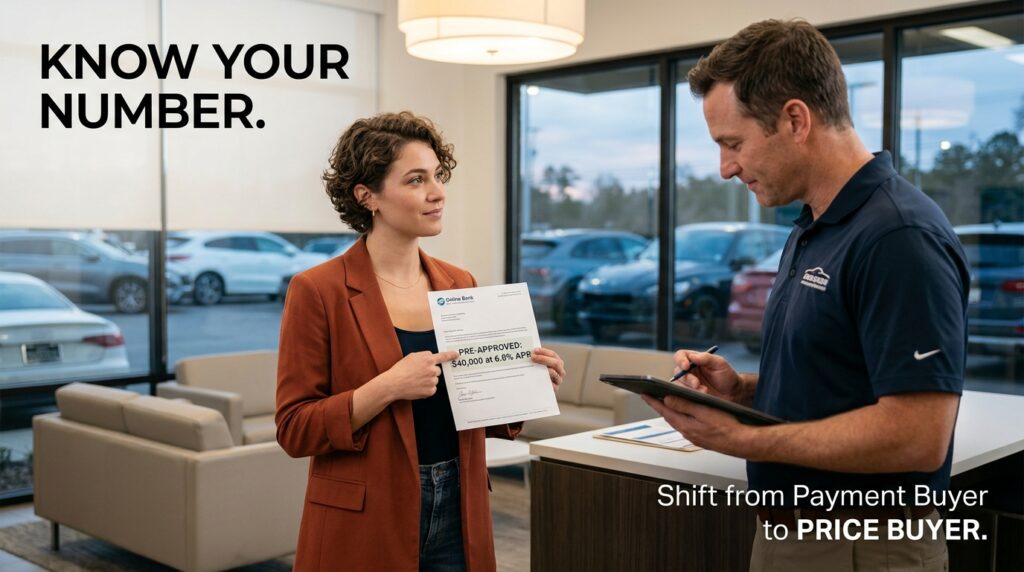
There is a huge psychological benefit to walking into a dealership knowing exactly how much you can spend. When you have an online lender’s approval for $40,000 at 6%, you are no longer a “payment buyer.” You become a “price buyer.”
You stop asking, “Can I afford the $800 a month?” and start asking, “Is this car worth the $40,000?” This shift in perspective is what prevents people from overbuying. Dealerships want you to think in small, monthly increments because it makes big numbers feel small. Online lenders, by their nature, force you to look at the big numbers first.
Conclusion: Making the Final Call
In the battle of Dealer Financing vs Online Lenders, there is no permanent winner—only the winner for your specific situation.
If you have a 780 credit score and the manufacturer is desperate to sell 2026 models with a 0.9% APR promo, the Dealer wins by a landslide. Grab that deal and don’t look back. It’s the closest thing to a “free” car you’ll ever find.
However, for everyone else—especially used car buyers or those looking at high-demand models—the Online Lender is your best financial ally. They provide the transparency and competitive edge needed to avoid the “dealer reserve” markup.
The smartest way to buy a car in 2026 is to do both. Get your online pre-approval first to see your “true” rate, and then let the dealer try to beat it. If they can, you win. If they can’t, you’ve already got your financing ready to go. Either way, you’re the one in control of the keys—and the contract. Safe driving!