
Imagine you’re standing at a crossroads. To your left, a sleek, silent Electric Vehicle (EV) that feels like it was plucked out of a sci-fi movie. To your right, a tried-and-true Internal Combustion Engine (ICE) vehicle, humming with that familiar mechanical rhythm we’ve known for a century. Both have roughly the same sticker price today, thanks to market shifts, but as you reach for your wallet, you realize the game has changed. It’s no longer just about miles per gallon versus kilowatt-hours; it’s about how the bank views your choice. The way we pay for our cars in 2026 has split into two very different financial paths.
For years, the debate was simple: EVs were expensive to buy but cheap to run, while gas cars were affordable upfront but drained your bank account at the pump. But as we settle into 2026, lenders have introduced a whole new layer of complexity. With “Green Loans,” specialized tax incentives, and varying depreciation curves, the question of “EV Financing vs Gas Car Loans: Which Is Cheaper?” doesn’t have a one-size-fits-all answer. You have to look at the total cost of the debt, not just the price of the metal. Let’s dive into the grit of the math and see which option actually wins for your specific lifestyle.
The Rise of the “Green Loan” Advantage
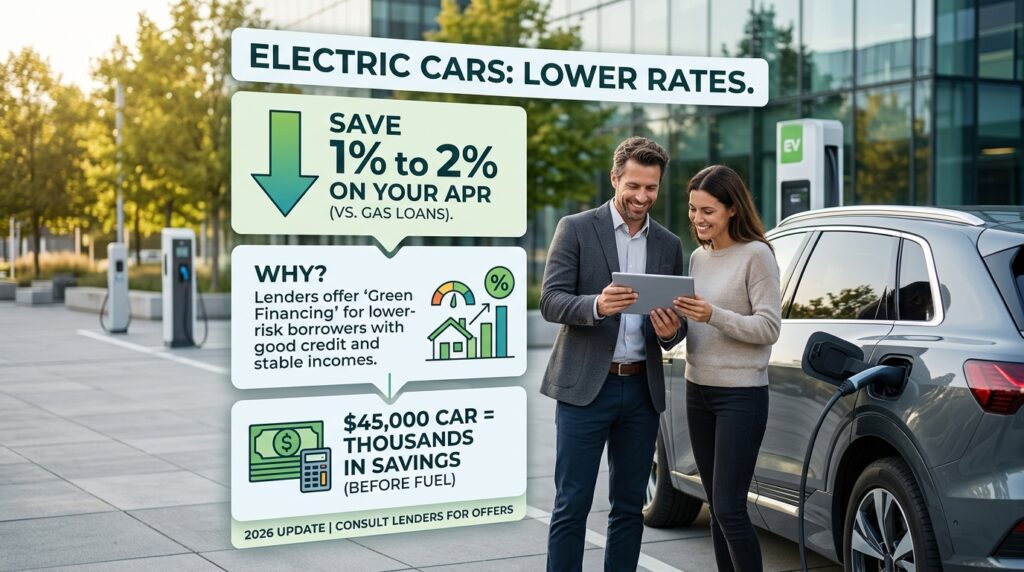
If you’re leaning toward an electric car, you’ve likely heard of “Green Financing.” In 2026, this isn’t just a marketing buzzword; it’s a specific financial product offered by credit unions and major banks. Because many governments and financial institutions are under pressure to meet sustainability goals, they are essentially “subsidizing” your interest rate if you ditch the gas tank.
It’s not uncommon to see a spread of 1% to 2% between an EV loan and a gas car loan for the same borrower. On a $45,000 car, that difference in APR can save you thousands before you even factor in the cost of fuel. Lenders see EV owners as a lower-risk demographic—often with higher credit scores and stable incomes—and they are fighting for that business with lower rates that gas cars simply can’t touch right now.
Depreciation: The Silent Budget Killer
We have to talk about the elephant in the room: resale value. A car loan is basically a race between how fast you pay the bank and how fast the car loses value. Historically, EVs took a massive hit in depreciation because battery technology was moving so fast that a three-year-old car felt ancient.
In 2026, that gap has narrowed, but it hasn’t disappeared. Gas cars still tend to have more predictable “exit prices.” If you take a 72-month loan on an EV, there’s a risk that by year four, the car is worth significantly less than what you owe, simply because a new model with double the range just hit the market. This “negative equity” risk can make EV financing more expensive in the long run if you don’t plan to keep the car until the wheels fall off.
Real-World Simulation: The $40,000 Showdown
Let’s put some real numbers on the board. We’ll assume you’re looking at a $40,000 vehicle with a $5,000 down payment over a 60-month term, assuming “Excellent” credit.
Scenario A: The Modern Gas SUV
-
APR: 6.5% (Standard Market Rate)
-
Monthly Payment: ~$685
-
Total Interest Paid: ~$6,100
-
Fuel/Maintenance (Monthly): ~$250
-
Effective Monthly Cost: $935
Scenario B: The New Electric Sedan
-
APR: 4.5% (Special Green Loan Rate)
-
Monthly Payment: ~$652
-
Total Interest Paid: ~$4,120
-
Charging/Maintenance (Monthly): ~$60
-
Effective Monthly Cost: $712
The Verdict: Even if the sticker prices were identical, the EV is nearly $220 a month cheaper when you combine the lower interest rate with the operational savings. Over five years, that is $13,200 back in your pocket. However—and this is a big however—this assumes you have a way to charge at home. If you rely on expensive public fast-chargers, that “fuel” gap starts to shrink.
The Maintenance Paradox
When you finance a gas car, you are financing a machine with thousands of moving parts, explosions, and friction. By year four of your loan, you’re likely paying for oil changes, spark plugs, and maybe a belt or two. These costs often get rolled into “emergency” credit card debt because they weren’t part of the car payment.
EVs are mechanically boring—in a good way. No oil changes, fewer moving parts, and regenerative braking that saves your pads and rotors. When you look at “EV Financing vs Gas Car Loans,” you have to account for the fact that the EV allows you to be much more aggressive with your loan payments because you aren’t setting aside $100 a month for “just in case” repairs.
Is an EV Loan Actually Worth It?
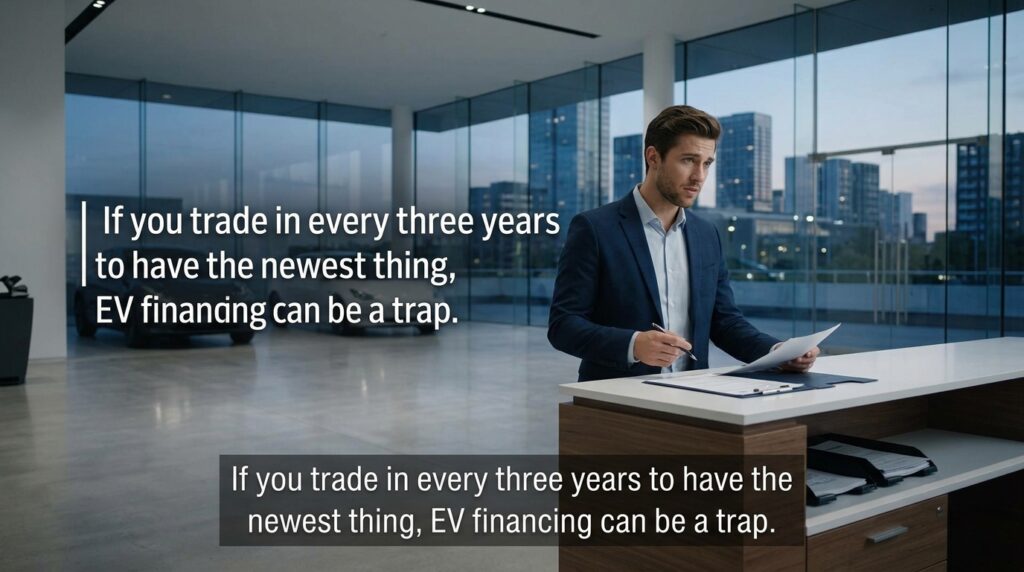
This depends entirely on your “holding period.” If you are the type of person who likes to trade in your car every three years to have the newest thing, EV financing can be a trap. The initial depreciation is still steeper, and you might find yourself needing to pay the bank extra cash just to get out of the loan.
But if you are a “long-hauler”—someone who keeps a car for 7 to 10 years—the EV is the undisputed champion. Once the loan is paid off in year five, you are driving a vehicle with almost zero operating costs, whereas the gas car owner is entering the most expensive maintenance years of the vehicle’s life. In 2026, the EV is a “front-loaded” expense that pays massive dividends in the second half of its life.
Critical Factors for the 2026 Buyer
Before you sign the dotted line, keep these three things in mind:
-
Tax Credit Timing: In 2026, many EV tax credits are applied at the “point of sale.” This means the $7,500 credit acts as an instant down payment. This is a massive win for EV financing because it lowers your “Loan-to-Value” ratio, often unlocking even better interest rates.
-
Insurance Spikes: Be careful—EVs can be more expensive to insure because they are often written off more easily after accidents due to battery repair costs. Always get an insurance quote for the specific EV model before you commit to the loan.
-
Home Infrastructure: Financing isn’t just about the car. If you need to spend $1,500 to install a Level 2 charger at home, you might want to roll that into your personal loan or car financing. Some lenders in 2026 actually allow you to bundle home charging equipment into the “Green Loan” package.
Pro-Tips for Navigating the Dealership
-
Don’t Mention the EV Credit Early: Negotiate the price of the car first. Once you have the lowest price, then bring in the tax credit and the green loan pre-approval. Some dealers will try to “eat” your tax credit by inflating the sale price of the EV.
-
Look for Manufacturer “Lease Loops”: Sometimes, leasing an EV is cheaper than financing because the manufacturer can pass on tax credits that don’t apply to a straight purchase. In 2026, many people are leasing for three years and then using a “lease buyout loan” once the technology has matured.
-
Check the “Residual Value” Insurance: Some high-end EV lenders now offer insurance that “guarantees” the value of the car in three years. If the market crashes, they cover the gap. It’s an extra fee, but it removes the biggest risk of EV financing.
The Psychological Shift
There is a certain “quiet” that comes with an EV loan—and I don’t mean the engine. It’s the psychological relief of knowing that a spike in global oil prices won’t derail your monthly budget. When you finance a gas car, you are tethered to a volatile commodity. When you finance an EV, you are essentially “pre-paying” for your transportation at a fixed, predictable rate.
For many 2026 buyers, that predictability is worth more than a few saved dollars. It’s the ability to look at your budget and know exactly what your commute will cost for the next 60 months, regardless of what’s happening in the news.

Conclusion: Weighing the Totals
In the showdown of EV Financing vs Gas Car Loans: Which Is Cheaper?, the EV takes the lead on paper, but only if you play your cards right. The combination of lower “Green Loan” interest rates, point-of-sale tax credits, and drastically lower running costs makes the EV a powerhouse for your long-term wealth.
However, the gas car remains the “safe” choice for those who can’t charge at home or those who plan to sell the car quickly. It offers a predictability in resale value that the EV market is still trying to master.
My advice? Run the numbers for your specific zip code. Look at the local utility rates and the specific “Green Loan” offers from your credit union. In 2026, the smartest car buyers aren’t just choosing a vehicle; they are choosing the financial structure that best protects their future. Whether you choose the hum of the engine or the whir of the motor, make sure the math is the one doing the heavy lifting. Safe driving!