
Let’s be honest: life moves fast, and sometimes your mailbox (or inbox) hits you with a credit card bill that makes your stomach drop. You look at the “Statement Balance” and then at the “Minimum Payment Due.” One is a mountain; the other is a tiny, manageable molehill. It’s incredibly tempting to just pay that small amount and tell yourself you’ll “catch up next month.” But that tiny payment is actually a golden ticket for the banks, and a one-way street into a debt cycle that is notoriously hard to break.
In the financial landscape of 2026, credit card terms have become more aggressive, and interest rates aren’t doing anyone any favors. If you’ve ever wondered why your balance barely moves despite making payments every month, you’re about to see the gears behind the machine. We’re going to peel back the curtain on how “Minimum Payments” actually work and why they are designed to keep you in debt for decades—literally.
The Anatomy of the “Minimum” Trap
When you only pay the minimum, you aren’t actually “paying off” your debt. You are mostly just covering the interest that accrued over the last thirty days, plus a tiny sliver of the actual money you spent. Banks typically calculate the minimum as 1% to 2% of the balance plus interest and fees.
This means that if you have a high balance, about 80% to 90% of your payment is just “rent” you’re paying to the bank to keep the debt alive. It’s the ultimate subscription service—one where you get no new content, and the price never goes down.
A 2026 Debt Simulation: The $10,000 Wake-Up Call
Let’s look at a realistic scenario for someone with a $10,000 credit card balance. In 2026, the average interest rate for someone with decent credit is hovering around 24% APR.
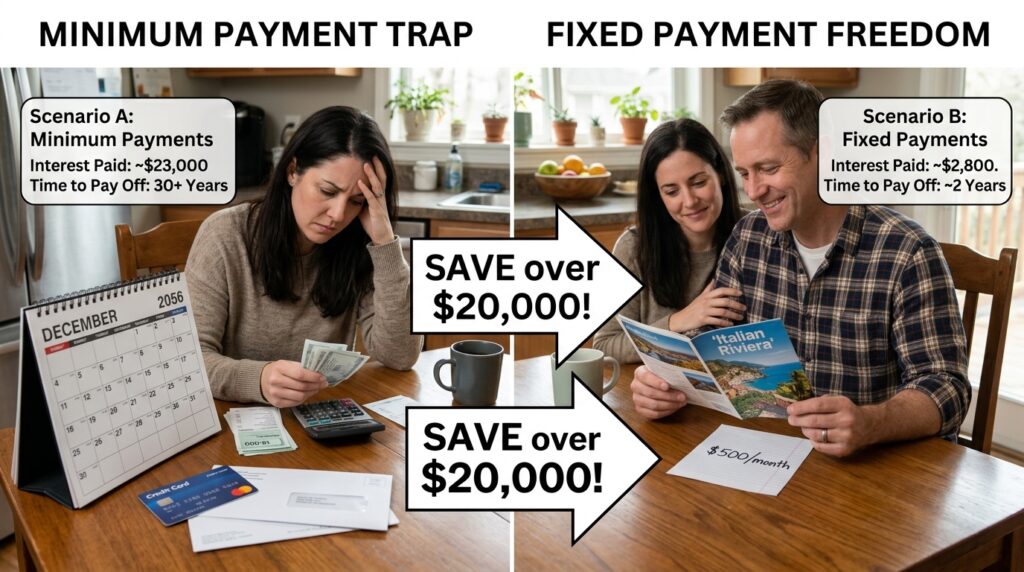
Scenario A: The Minimum Only Path
-
Starting Balance: $10,000
-
Monthly Payment: ~$250 (declining as balance drops)
-
Time to Pay Off: 30+ Years
-
Total Interest Paid: ~$23,000
-
Total Cost: $33,000
Scenario B: The “Fixed” Payment Strategy
-
Starting Balance: $10,000
-
Monthly Payment: $500 (Consistent every month)
-
Time to Pay Off: ~26 Months
-
Total Interest Paid: ~$2,800
-
Total Cost: $12,800
The Insight: By simply deciding to pay a fixed $500 instead of the sliding minimum, you save over $20,000 in interest and gain nearly 28 years of your life back. In Scenario A, you ended up paying for your $10,000 of purchases three times over. That is the staggering reality of how interest compounding works against you.
Red Flags to Watch For in Your Statement
Most people don’t read the fine print on their monthly statements, but the “Minimum Payment Warning” box is required by law for a reason. Here is what you should be looking at to gauge the health of your finances:
-
The “Interest Charge” vs. “Principal” Ratio: If your interest charge is more than half of your payment, you are in the danger zone.
-
The Payoff Timeline: If the box says it will take 20 years to pay off the balance by making minimum payments, that is a mathematical alert that your debt is currently unmanaged.
-
Variable Rates: In 2026, many cards have variable APRs tied to the prime rate. If the central bank raises rates, your “minimum” might stay the same, but the amount going toward your actual balance will shrink even further.
Strategies to Kill the Interest Monster
If you’re currently stuck in the minimum payment cycle, you don’t need a miracle; you need a system. Here are the most effective ways to pivot:
-
The Debt Snowflake: We’ve all heard of the “Snowball” (paying small debts first) or the “Avalanche” (paying high interest first). The “Snowflake” is about the little things. Did you skip a $6 coffee today? Immediately transfer that $6 to your credit card. Found $20 in an old coat? Put it on the card. These tiny, extra payments hit the principal directly and stop future interest from ever forming.
-
Balance Transfer Tactics: If your credit is still in good shape, moving a 24% APR balance to a 0% APR “introductory” card can be a lifesaver. However, you must be disciplined. If you use the 0% card to buy more things, you’ve just doubled your problem.
-
Personal Loan Refinancing: Sometimes, taking out a personal loan at 10% or 12% to pay off a 24% credit card is the smartest move. It turns a “revolving” debt into a “fixed” debt with a clear end date.

The Mindset Shift: From Consumer to Owner
The biggest obstacle isn’t the math—it’s the habit. We’ve been conditioned to think about “affordability” in terms of monthly payments. “I can afford $200 a month,” we say. But we should be saying, “I refuse to let $5,000 of my future labor go to a bank for nothing.”
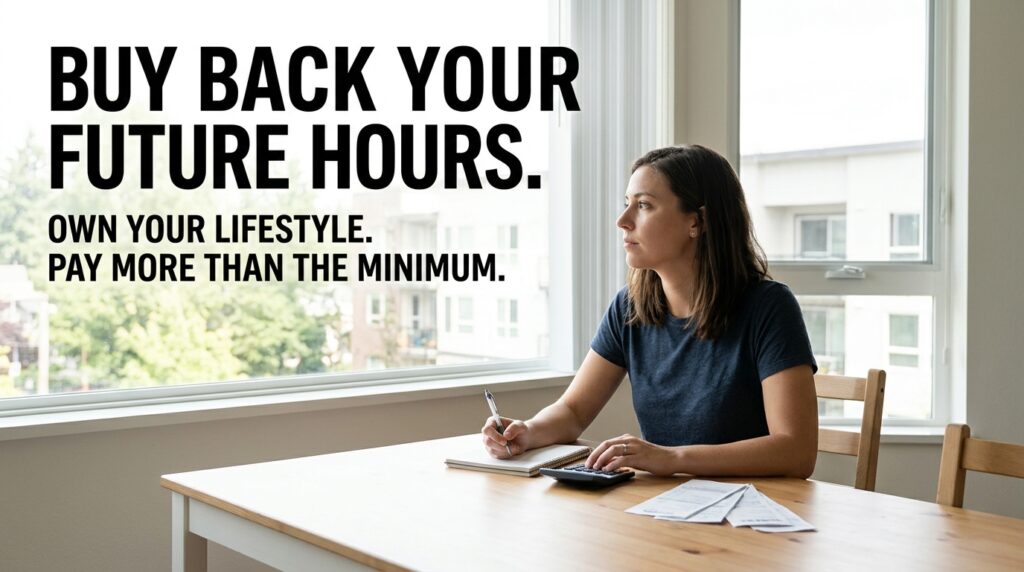
When you start paying more than the minimum, you are essentially “buying back” your future hours. Every dollar over the minimum is a dollar you won’t have to work for later. It’s a shift from being a “renter” of your lifestyle to being the owner of it.
Final Thoughts
The real cost of credit card interest isn’t just the dollars and cents; it’s the missed opportunities. It’s the house down payment you don’t have, the retirement you have to delay, or the stress that keeps you up at 2 AM.
Paying the minimum is a trap designed to look like a lifeline. By understanding the simulation—knowing that $10,000 can easily turn into $33,000—you gain the power to change the outcome. Break the cycle by paying even a little bit more than required, stay consistent, and watch how fast the mountain starts to crumble. Your future self will thank you for the $20,000 gift you just gave them by being smarter than the system.