
Walking onto a car lot in 2026 feels a bit like stepping into the future. The vehicles are sleeker, the technology is smarter, and the prices—well, the prices have certainly kept pace with the innovation. As sticker prices have climbed, a new financial “hero” has emerged in the dealership finance office: the 84-month car loan. On the surface, it looks like a miracle for your monthly budget. By stretching the payments over seven long years, that high-tech SUV suddenly costs the same per month as a basic hatchback used to. But as any seasoned driver or financial advisor will tell you, there is no such thing as a free lunch in the world of compound interest.
The 84-month loan is a tool that has sparked intense debate among automotive experts and financial planners alike. To some, it’s a predatory trap designed to keep consumers in a perpetual cycle of debt. To others, it’s a necessary adaptation to a world where cars have become essential, high-priced assets. Before you sign your name to a contract that won’t end until the next decade, you need to understand the mechanics of what you are actually buying. Is this a savvy way to manage cash flow, or are you just paying a massive premium for the illusion of affordability? Let’s pull back the curtain on the seven-year loan.
What Exactly Is an 84-Month Car Loan?
In the traditional automotive world, a “long” loan was 60 months (five years). For a long time, that was the industry standard. However, as vehicle prices surged and interest rates fluctuated, lenders began offering 72-month and eventually 84-month terms. This means you are committing to 84 individual monthly payments.
The math is simple: the longer the term, the lower the monthly payment. If you borrow $40,000, spreading that debt over seven years instead of four makes the monthly check much easier to write. However, while the principal is spread thin, the interest has much more time to grow. In 2026, where digital lending makes these offers pop up instantly on your smartphone, it’s easier than ever to fall for the low monthly number without looking at the “total cost of ownership” at the end of the road.

The Allure: Why Drivers Are Sayings “Yes”
It’s easy to judge someone for taking a seven-year loan, but the reality of 2026 is that many people feel they have no choice. Cars are more expensive than ever, partly due to advanced safety features and the transition to electric powertrains.
Cash Flow Management
For many families, the monthly payment is the only number that matters. If an 84-month loan means the difference between driving a reliable, safe vehicle with a warranty or a high-mileage “clunker” that might break down next week, the longer term feels like a safety net. It allows for more “breathing room” in a tight monthly budget, freeing up cash for rent, groceries, or childcare.
Lower Barriers to Entry
Longer terms allow buyers to “punch above their weight class.” You might be able to afford the monthly payment on a premium trim level or a luxury brand that would be impossible on a 48-month schedule. For some, the prestige and comfort of a better car are worth the long-term commitment.
The Hidden Dangers: Is It Really a Trap?
This is where we have to look at the cold, hard numbers. While the monthly payment is small, the total interest paid over 84 months can be staggering. Lenders often charge higher interest rates for longer terms because they are taking on more risk over a longer period.
The Interest Mountain
Consider a $35,000 loan at 7% interest. Over 60 months, you’d pay about $6,500 in total interest. If you stretch that to 84 months, even if the rate stays the same, you’ll pay over $9,300 in interest. If the bank bumps your rate to 8% because of the longer term, you’re looking at over $11,000 in interest. You are essentially paying for a small second car just in interest charges.
The “Underwater” Nightmare
Vehicles are depreciating assets. They lose value the moment you drive them off the lot. In an 84-month loan, you are paying down the principal so slowly that the car’s market value often drops faster than your loan balance. This is called being “underwater” or having “negative equity.” If you get into an accident and the car is totaled, or if you need to sell the car in year four, you might owe the bank $5,000 more than the car is actually worth.
Outlasting the Warranty
Most bumper-to-bumper warranties end at 36,000 or 60,000 miles (usually 3 to 5 years). By year six and seven of your loan, you will likely be facing expensive repairs—new tires, brake work, or battery issues—while still making a full monthly payment to the bank. This “double whammy” of a car payment plus high maintenance costs is what often leads to financial distress for long-term borrowers.
Comparison: 60 Months vs. 84 Months
Let’s look at a realistic 2026 example for a $45,000 Electric SUV.
Option A: 60-Month Loan (5-year)
-
Interest Rate: 6%
-
Monthly Payment: $870
-
Total Interest Paid: $7,190
-
Total Cost: $52,190
Option B: 84-Month Loan (7-year)
-
Interest Rate: 7.5% (Higher for longer term)
-
Monthly Payment: $691
-
Total Interest Paid: $13,044
-
Total Cost: $58,044
In this scenario, you “save” $179 every month. But to get that “saving,” you agree to pay an extra $5,854 to the bank. Is that monthly breathing room worth nearly six thousand dollars? For some, yes. For most, that is a very expensive way to borrow.
Vale a pena? (Is it worth it?)
Determining if The Truth About 84-Month Car Loans (Are They a Trap?) ends in a “yes” depends on your intent. If you are taking the 84-month loan with the specific goal of paying it off early, it can act as a flexible insurance policy. You have a low “required” payment if things go wrong, but you pay extra every month to kill the debt in five years.
However, if you are taking the loan because you cannot afford a cent more than that monthly payment, you are in a high-risk zone. You are betting that your life, your job, and your car will all remain perfectly stable for the next seven years. In a world that moves as fast as 2026, seven years is an eternity. Generally speaking, if you need 84 months to afford the car, you are likely buying more car than your current finances can truly support.
O que considerar antes de escolher (What to consider before choosing)
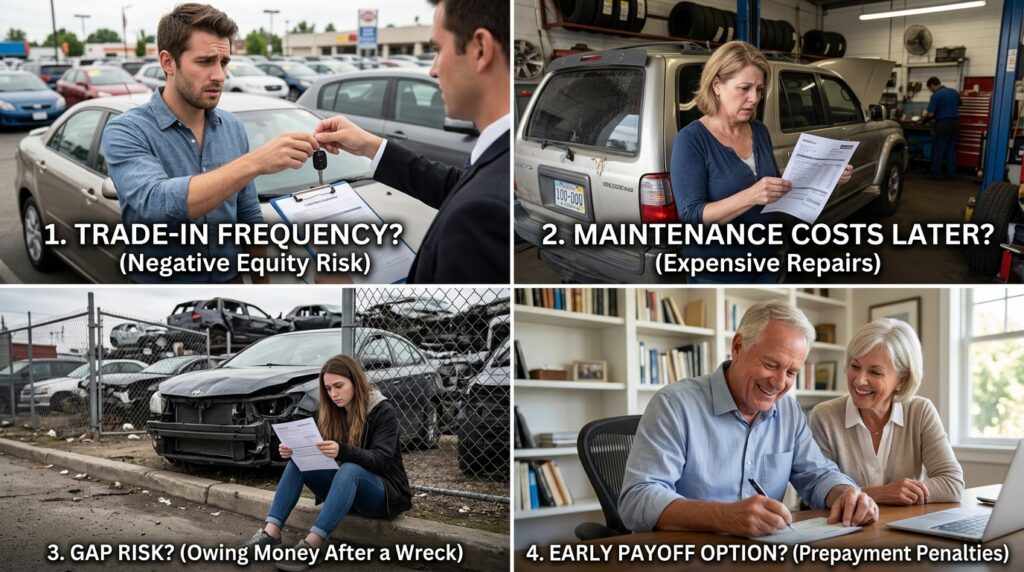
Before you sign on the dotted line, ask yourself these four questions:
-
How long do I usually keep my cars? If you like to trade in every three or four years, an 84-month loan is a financial disaster. You will almost certainly have negative equity when you go to trade, which will be rolled into your next loan, creating a “debt snowball.”
-
Does the car have a reputation for longevity? If you are financing a car known for being expensive to maintain after 100,000 miles, an 84-month loan is a recipe for disaster. You’ll be paying for a broken car.
-
What is the “Gap”? If you take a long loan, GAP insurance is mandatory. Without it, a total-loss accident in year three could leave you owing the bank thousands for a car that is in a junkyard.
-
Can I pay it off early? Check for prepayment penalties. If the loan allows you to pay extra toward the principal without penalty, the 84-month term becomes much less dangerous.
Dicas importantes (Important tips)
If you find yourself looking at an 84-month offer, use these strategies to protect yourself:
-
Put More Down: A 20% down payment can help prevent you from going “underwater” even on a long loan. It keeps your loan-to-value ratio healthy from day one.
-
Shop the Rate: Don’t just take the dealer’s 84-month offer. Check credit unions. They often have much lower rates for long-term loans than the manufacturer’s captive finance arm.
-
The “Payment Plus” Strategy: If you take the 84-month loan for the “safety” of a low payment, try to pay the 60-month payment amount whenever you can. This drastically reduces the interest you pay and builds equity faster.
-
Watch the Tech: In 2026, automotive technology (especially in EVs and self-driving systems) is moving fast. An 84-month-old car might feel ancient by the time you own it. Consider if you’ll still love the car in year seven.
The Psychological Trap: The Perpetual Payment
Perhaps the biggest danger of the 84-month loan is psychological. When you are always in a car loan, you never experience the “wealth-building” phase of car ownership—those years where you have no payment and can put that money into your savings or retirement.
By the time you finish an 84-month loan, the car is often ready to be replaced, leading you straight into another 84-month loan. You essentially turn a car into a permanent subscription service, but at a much higher price than a traditional lease or purchase. This “trap” keeps you from ever truly owning your transportation.

Conclusion
So, are they a trap? For the unprepared and the impulsive, yes. The 84-month car loan is designed to make expensive cars look affordable, masking the true cost of interest and depreciation. It preys on our desire for the “new and shiny” while ignoring the long-term health of our bank accounts.
However, it is also a tool. In the hands of a disciplined buyer who understands the risks, uses GAP insurance, and plans to pay the loan off ahead of schedule, it provides a level of monthly flexibility that can be helpful in an uncertain economy.
Before you commit to a seven-year relationship with a car and a bank, take a long look at the total interest. If that number makes you wince, it’s a sign that you should probably look for a more affordable vehicle or a shorter term. The best car is the one that gets you where you need to go without making you a slave to your monthly statement. Choose wisely, read the fine print, and always keep an eye on the “Total Cost” line—not just the monthly one. Happy driving!