
In the world of automotive finance, few phrases are as dreaded as “being underwater.” Professionally known as negative equity, it describes a situation where the balance of your car loan is higher than the actual market value of the vehicle. If you owe $25,000 on a car that a dealer will only give you $18,000 for, you have $7,000 in negative equity.
In 2026, avoiding this trap has become more challenging but more essential than ever. With vehicle prices stabilizing and interest rates remaining a significant factor, many buyers find themselves trapped in loans for cars they can’t afford to sell or trade.

To be a smart buyer, you must view your car purchase as a race between two declining lines: the value of your car and the balance of your loan. Here is how to ensure your loan balance always hits the ground faster than your car’s value.
The Anatomy of the Negative Equity Trap
Negative equity doesn’t happen by accident; it’s usually the result of a “perfect storm” of high-interest rates, low down payments, and long loan terms. When you drive a new car off the lot, it immediately loses a significant chunk of its value—often 10% to 15%—the moment the tires hit the public road.
If you financed 100% of the purchase price, including taxes and fees, you are technically in a negative equity position before you even reach the first traffic light. Most people eventually “climb out” of this hole as they make payments, but if your loan term is too long or your interest rate is too high, you might stay underwater for three, four, or even five years.
1. The 20% Down Payment: Your Financial Buffer
The most effective weapon against negative equity is the upfront down payment. While “zero-down” deals are marketed heavily because they lower the barrier to entry, they are the primary cause of financial instability in car ownership.
By putting 20% down, you are essentially pre-paying for the initial depreciation “hit” that every car takes. If the car loses 20% of its value in the first year, but you already paid for 20% of the car with your own cash, your loan balance stays roughly equal to the car’s value.
This buffer is your safety net. If you lose your job, decide you need a different vehicle, or have an emergency, you can sell the car and pay off the loan entirely without having to reach into your savings to cover the gap.
2. Avoid the 72 and 84-Month Loan Trap
Dealerships love long-term loans because they make expensive cars look affordable. A $50,000 SUV looks much more tempting at $650 a month for 84 months than it does at $950 for 60 months.
However, long-term loans are the “slow-motion” path to negative equity. During the first two years of an 84-month loan, the vast majority of your monthly payment goes toward interest, not the principal. Meanwhile, the car is depreciating at its fastest rate.
To stay “above water,” aim for a loan term of 48 to 60 months. If you cannot afford the payment at 60 months, it is a clear indicator that the car is outside of your sustainable price range. Shorter loans force you to build equity in the asset much faster.
3. Choose Vehicles with Strong Resale Value
Not all cars depreciate at the same rate. Some vehicles are like stones falling off a cliff, while others are like feathers drifting slowly to the ground. Your choice of brand and model is a major factor in your equity position.
The Reliability Premium
Brands with high reliability ratings—think Toyota, Honda, and Subaru—consistently hold their value better than their competitors. A three-year-old Toyota Tacoma might still be worth 75% of its original price, whereas a luxury sedan might only be worth 50%.
Avoiding “Niche” or Over-Hyped Models
Cars that are “trendy” often see a massive drop in value once the hype dies down or a newer version is released. When you finance a vehicle that the market consistently wants (like a mid-sized SUV or a reliable hybrid), you ensure there will always be a buyer ready to pay a fair price, protecting your equity.
4. The Danger of Rolling Over “Old Debt”
The fastest way to ruin your financial future is to “roll over” negative equity from your current car into a new loan. Dealerships make this sound easy: “Don’t worry that you owe $5,000 more than your trade-in is worth; we will just add that to your new loan!”
This is a catastrophic mistake. You are now financing a new car plus “phantom debt” from a car you no longer own. You will be paying interest on that $5,000 for the next five to seven years.
If you are currently underwater on your car, the smartest move is to keep driving it. Continue making payments until you reach the “break-even” point. Rolling debt forward creates a snowball effect that eventually leads to a situation where you owe $40,000 on a $20,000 car, leaving you with no exit strategy.
5. Pay Your Taxes and Fees Upfront
When you buy a car, there are always extra costs: sales tax, registration fees, and dealer documentation fees. On a $30,000 car, these can easily add up to $2,500 or $3,000.
If you roll these fees into your loan, you are borrowing money for things that have zero resale value. You can’t sell “sales tax” to someone else later. Always try to pay these costs in cash at the time of purchase. This ensures that every dollar you finance is actually tied to the physical asset of the car.
6. The Role of GAP Insurance
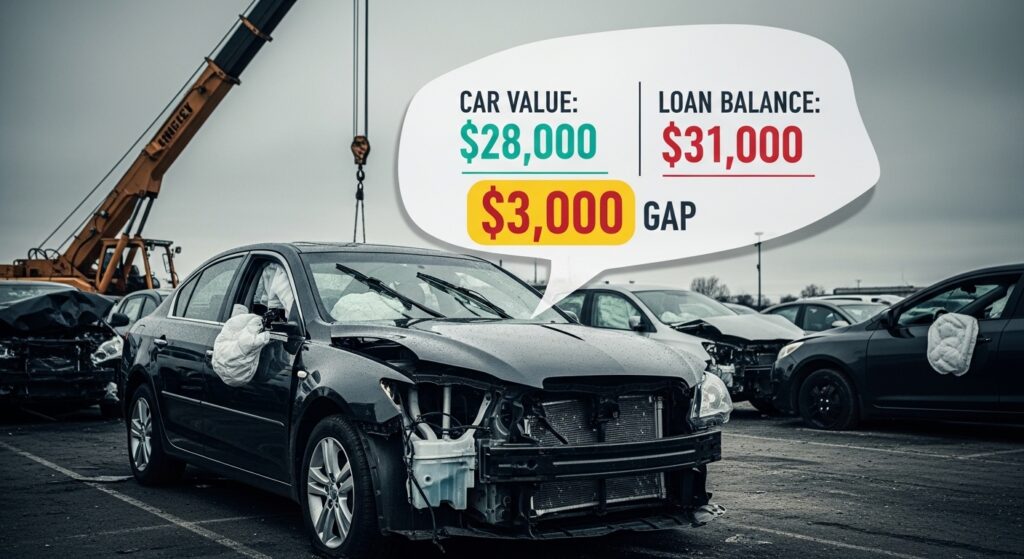
Even if you do everything right, a total-loss accident in the first year of ownership can leave you with a financial gap. If your car is worth $28,000 but your loan is $31,000, and the car is totaled, your insurance company will only pay the $28,000 market value.
GAP (Guaranteed Asset Protection) insurance covers that $3,000 difference. While GAP doesn’t prevent negative equity, it prevents negative equity from destroying your bank account in the event of an accident.
Pro Tip: Do not buy GAP insurance from the dealership. It is usually much cheaper (often just a few dollars a month) to add it directly to your existing auto insurance policy.
7. Make Bi-Weekly or Extra Principal Payments
If you already have a loan and you’re worried about being underwater, you can change the math by changing your payment habits.
Instead of one monthly payment, split it in half and pay every two weeks. Because there are 52 weeks in a year, you will end up making 26 half-payments, which equals 13 full payments per year instead of 12.
Additionally, any time you have a “windfall”—like a tax refund or a work bonus—put a portion of it directly toward the principal of your car loan. Reducing the principal balance early in the loan’s life has a massive compounding effect on how quickly you build equity.
8. Beware of High-Interest Rates
Interest is the “friction” that slows down your equity growth. If you have an 8% interest rate, a huge portion of your monthly payment is being “burned” before it ever touches the principal of the loan.
If your credit was poor when you bought the car but has improved since, look into refinancing. Dropping your rate from 9% to 5% could mean that an extra $40 or $50 of your payment goes toward the car every month. Over a few years, that’s thousands of dollars in equity you wouldn’t have otherwise had.
The “Lease” Alternative
If you know for a fact that you want a new car every three years and you don’t want to worry about market fluctuations, leasing is the “guaranteed” way to avoid negative equity.
When you lease, you are essentially “renting” the depreciation. At the end of the three years, you simply hand the keys back. Even if the car’s market value has plummeted, it is the bank’s problem, not yours. However, this only works if you stay within mileage limits and keep the car in good condition.
Final Thoughts
Negative equity is a symptom of “buying more car than you can afford.” In 2026, the marketing will tell you that a low monthly payment is all that matters, but a smart buyer knows that the total balance and the asset value are the true indicators of financial health.
By putting 20% down, choosing a shorter loan term, and picking a vehicle that holds its value, you aren’t just buying a car—you’re protecting your future mobility. Being “above water” gives you freedom. It means you can sell the car when you want to, not just when the bank says you can.
Stay disciplined, do the math before you walk into the showroom, and always keep your loan balance on a shorter leash than your car’s depreciation curve.