
Life has a way of throwing curveballs when we least expect them. Maybe a medical emergency drained your savings, or perhaps a rough patch in your career left your credit score looking a bit bruised. In the middle of these challenges, your old car decides to give up the ghost, leaving you stranded without a way to get to work or pick up the kids. When you visit a traditional dealership, the finance manager shakes their head, citing a “computer says no” policy due to your credit history. This is usually the moment you see a bright, hand-painted sign on a corner lot that reads: “No Credit? No Problem! Buy Here, Pay Here!” It sounds like a lifeline, a way to reclaim your mobility when the rest of the world has shut its doors.
But before you pull over and start picking out a car, it is vital to understand the mechanics of the “Buy Here Pay Here” (BHPH) world. In 2026, while the automotive market has become more digital and transparent, BHPH dealerships remain a unique and often misunderstood corner of the industry. Unlike traditional dealerships that connect you with a bank, these lots are the bank. They sell you the car and they hold the loan. It is a high-stakes, high-interest environment where convenience and accessibility come at a very specific price. As someone who has spent years helping people navigate the muddy waters of auto financing, I want to give you the honest truth about whether these lots are a genuine opportunity or a financial minefield.
How Buy Here Pay Here Really Works
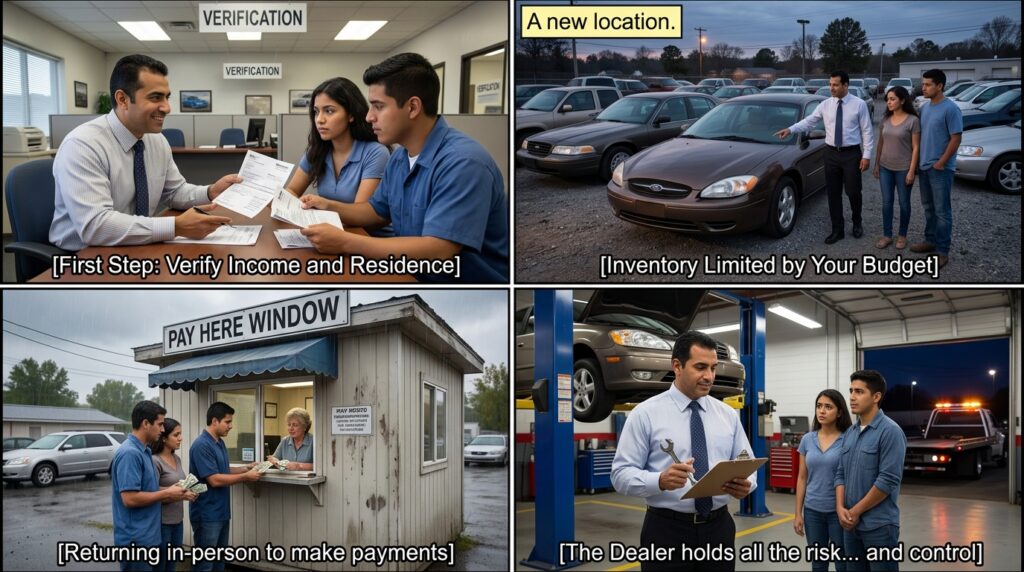
To understand the BHPH model, you have to realize that the “car” is often secondary to the “loan.” In a traditional setup, you find a car, and then you talk about financing. At a Buy Here Pay Here lot, the process is reversed. The first thing they will do is verify your income and your residence. Once they know how much you make, they will tell you which cars on the lot you are “allowed” to buy based on the weekly or bi-weekly payment you can afford.
The term “Buy Here Pay Here” is literal. In many cases, you aren’t just sending a digital payment to a giant bank in another state. You are often expected to return to the dealership—sometimes in person—to make your payments. While many have modernized with online portals by 2026, the underlying principle remains: the dealer is your landlord, your banker, and your mechanic all rolled into one. They take on the risk that no one else will, and they structure their business to protect themselves against that risk.
The Attraction: Why People Choose BHPH
It is easy for financial gurus to tell people to “just avoid” these lots, but for many, that isn’t a realistic option. There are legitimate reasons why thousands of drivers choose this path every single month.
Immediate Accessibility
The biggest advantage of Buy Here Pay Here Dealerships: Worth It or Risky? conversations usually starts with the word “Yes.” When your credit score is in the 400s or 500s, getting a “yes” feels like a miracle. BHPH lots don’t care about your past bankruptcies or your late credit card payments. They care about your current job and your ability to pay them today. For someone who needs a car to keep their job, this accessibility is invaluable.
Streamlined Process
There is no waiting for bank approvals that take 48 hours. You walk in, show your pay stubs, pick a car from the “approved” list, and drive home. It is a one-stop-shop in the truest sense. For a busy parent or a worker with limited time, the lack of bureaucratic hurdles is a significant draw.
The Opportunity for a Fresh Start
In rare cases, some BHPH lots report your on-time payments to the credit bureaus. If you find one that does, it can be a slow but steady way to rebuild your credit. However, you must verify this before signing, as many of these lots do not report positive data—only negative data if you fail to pay.
The Risks: What the Fine Print Doesn’t Tell You
The “risks” associated with BHPH aren’t just about high interest rates; they are about the structure of the deal itself. You have to be incredibly careful because the deck is often stacked in favor of the house.
Astronomical Interest Rates
Because the dealer is taking a massive risk on someone with poor credit, they charge for it. In 2026, it is not uncommon to see interest rates at 20%, 25%, or even 30%. On a $10,000 car, you might end up paying $18,000 or more by the time the loan is finished. You aren’t just paying for a car; you are paying for the “privilege” of borrowing money.
Overpriced Inventory
BHPH dealers often buy their cars at auctions for very little money and sell them for significantly more than their “Blue Book” value. Because they know their customers can’t shop elsewhere, they can inflate the price. You might pay $8,000 for a car that is worth $4,500 on the open market.
The “Kill Switch” and Repossession
Many BHPH cars are equipped with GPS trackers and starter-interrupt devices. If you are even a day late on your payment, the dealer can remotely disable your car so it won’t start. This allows them to repossess the vehicle quickly and easily. Some “churn and burn” lots actually rely on this model—selling the same car to five different people in a single year as each one fails to keep up with the aggressive payment schedule.
Comparative View: BHPH vs. Traditional Subprime
If you’re considering a BHPH lot, it’s worth comparing it to a “subprime” loan from a traditional dealer.
-
Traditional Subprime: The dealer finds a bank (like Westlake or Santander) to fund you. The interest is high (15-18%), but the car price is usually closer to market value, and your payments almost always help build your credit score.
-
Buy Here Pay Here: The dealer funds you. The interest is very high (20-30%), the car is often overpriced, and your payments might not help your credit score at all.
If you can get a subprime loan at a traditional dealership, it is almost always a better financial move than going to a BHPH lot.
Is it worth it?
Determining if Buy Here Pay Here Dealerships: Worth It or Risky? results in a “worth it” answer depends entirely on your lack of other options.
If you have tried every credit union, every traditional dealer, and even “subprime” lenders, and everyone has said no—and you must have a car to keep your livelihood—then a BHPH lot can be a temporary, necessary evil. It is worth it only as a short-term bridge to get you back on your feet.
However, if you have any other choice, even if it means driving a much older car or saving for a few more months to buy a $3,000 “beater” with cash, the BHPH route is rarely worth the long-term financial damage. The “trap” of high interest and overpayment can keep you in a cycle of debt that is hard to escape.
What to consider before choosing
Before you hand over your down payment and sign that contract, you need to be a detective. Consider these factors:
The Mechanical Condition BHPH cars are often sold “As-Is.” This means if the transmission falls out two blocks away, it is your problem, not theirs. In 2026, even a used car should be inspected. Ask if you can take the car to an independent mechanic for a “pre-purchase inspection” (PPI). If they say no, walk away immediately.
The Payment Schedule Does the payment align with your paydays? If you get paid every two weeks but the dealer demands a weekly payment, you are going to struggle. Make sure the schedule is realistic for your lifestyle.
The Reputation of the Lot Check online reviews. Look for patterns. Do people complain about cars breaking down immediately? Do they complain about the dealer being “predatory” with repossessions? In the age of social media, bad dealers have a hard time hiding their tracks.

Important tips
If you have decided that a BHPH lot is your only path forward, use these strategies to protect yourself from the worst-case scenarios:
-
Bring a Car-Savvy Friend: If you aren’t a “car person,” bring someone who is. Have them look for signs of major leaks, frame damage, or “cleared” engine codes.
-
Negotiate the Down Payment: BHPH dealers love a big down payment because it covers their initial investment in the car. If you can lower the down payment, you keep more cash in your pocket for potential repairs.
-
Ask About Reporting: Explicitly ask: “Do you report my on-time payments to Experian, Equifax, or TransUnion?” If they don’t, the loan isn’t helping your future.
-
Check the Warranty: Some “reputable” BHPH lots will offer a short 30 or 90-day powertrain warranty. This is a huge green flag. It shows they have at least some confidence in the cars they are selling.
-
Have an Exit Strategy: Plan to refinance the car or sell it as soon as your credit score improves. Don’t plan to stay in a 25% interest loan for four years if you can help it.
The Reality of 2026: Modern BHPH
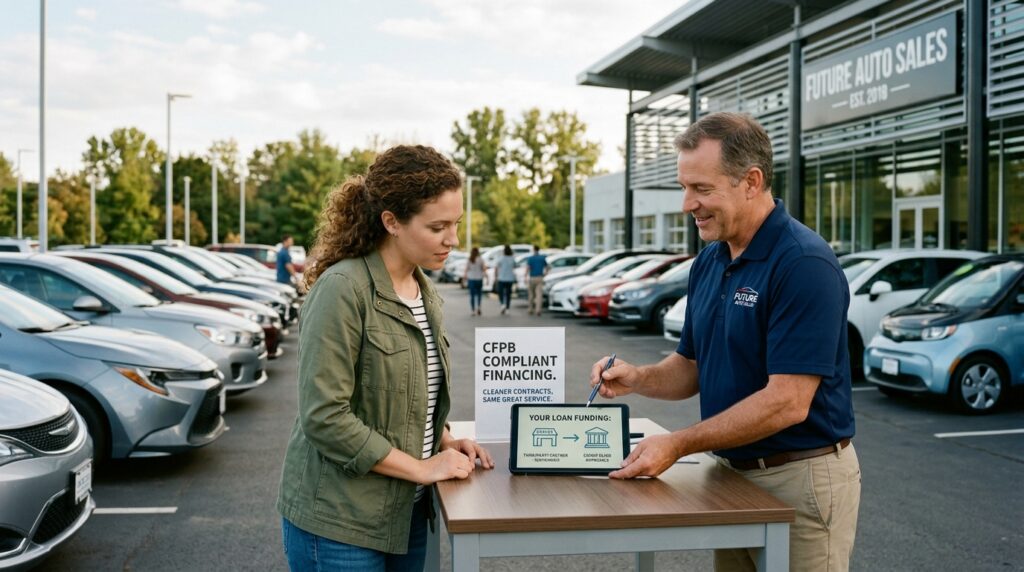
In 2026, the BHPH industry has faced more scrutiny from the Consumer Financial Protection Bureau (CFPB). This means the contracts are generally “cleaner” than they were a decade ago, but the high costs remain. We are also seeing “Hybrid BHPH” models where the dealer uses a third-party finance company but maintains the “credit-blind” approval process. These can sometimes offer better terms, so it pays to ask how the loan is actually funded.
Conclusion
When we ask, Buy Here Pay Here Dealerships: Worth It or Risky?, the answer is clearly: both. It is a risky financial environment that preys on the desperate, but it is also a vital “last resort” for those who have been excluded from the traditional banking system.
If you find yourself on one of these lots, don’t let the “easy” approval cloud your judgment. Treat the transaction with more scrutiny than a normal car purchase, not less. Check the car’s history, verify the interest rates, and make sure you aren’t paying double what the car is worth.
A car should be a tool that helps you move forward in life, not an anchor that keeps you stuck in a cycle of high-interest debt. If you use a BHPH lot, use it as a stepping stone—pay it off, build your credit, and make sure your next car comes from a place where the “computer says yes” to a fair, low-interest rate. Safe driving, and keep your eyes on the road ahead!